





From Atiku Sarki, Abuja
As the 2027 general elections approach, the Diplomatic Correspondents Association of Nigeria (DICAN) has called for political party discipline, greater accountability and far-reaching anti-corruption reforms to strengthen the country’s democratic institutions.
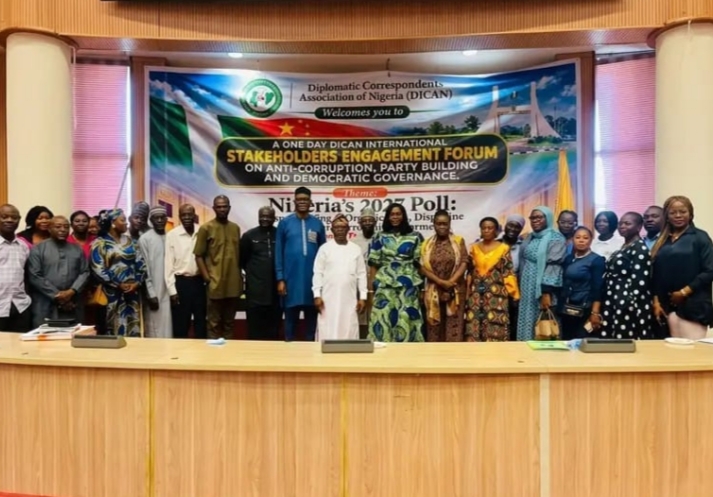
The association made the call on Wednesday in Abuja at a one-day seminar organised under the theme, “Nigeria’s 2027 Poll: Promoting Party Organisation, Discipline and Anti-Corruption Reforms: Lessons from Xi Jinping’s Thoughts.”
The seminar, held at the Rotunda Hall of the Ministry of Foreign Affairs, brought together diplomats, government representatives, political party leaders, academics, civil society organisations, media practitioners and other stakeholders to examine China’s governance experience and its possible lessons for Nigeria.
In his remarks, the Chairman of DICAN, Mr Frederick Idehai, called on political parties and their supporters to abide by the country’s constitutional laws, strengthen internal democracy, promote transparency and accountability, and avoid actions capable of triggering political violence during the forthcoming 2027 general elections.
According to Idehai, Nigeria’s democratic progress should go beyond conducting elections to building credible institutions and responsible political organisations.
Examining China’s governance model, he said the objective was not to replicate its political system but to identify useful practices that could improve Nigeria’s democratic institutions.
He stressed that relevant lessons must be adapted to the country’s constitutional provisions and multiparty democratic structure.
The DICAN Chairman, who is also a former Chairman of the Correspondents’ Industry, Commerce Association of Nigeria (CICAN), assured the association’s readiness to cooperate and partner with the Ministry of Foreign Affairs, other government agencies and diplomatic missions in effectively reporting their activities.
Speaking at the seminar, the representative of the Chinese Embassy in Nigeria, Counsellor Dong Hairong, disclosed that approximately 8.1 million corruption cases had been recorded in China since 2012, with more than 7.9 million officials subjected to disciplinary and administrative sanctions.
According to Hairong, the figures also included more than 900 senior officials at vice-ministerial level and above.
The Chinese representative reaffirmed her country’s commitment to strengthening accountability, institutional supervision and the enforcement of disciplinary measures.
She also expressed China’s readiness to share relevant experiences with Nigeria and deepen cooperation in governance and anti-corruption initiatives.
In his remarks, the Minister of State for Foreign Affairs, Ambassador Bianca Odumegwu-Ojukwu, who was represented by a senior official of the ministry, commended the DICAN Chairman and members of the association for their contributions to projecting Nigeria’s foreign policy objectives and priorities through their reportage.
He said their work had continued to inform the Nigerian public while promoting friendly relations with countries across the world.
“The Ministry of Foreign Affairs appreciates your partnership and looks forward to further consolidating it as we continue to advance our national aspirations in our engagements with the international community,” he said.
Commenting on the subjects that frequently feature in Nigeria’s national discourse, namely anti-corruption, party building and democratic governance, the minister noted that the three components were yet to be fully integrated into the country’s national development efforts.
He stressed that political parties, the media, civil society organisations and government institutions had important roles to play in achieving these objectives.
He expressed the expectation that participants would make meaningful contributions and offer recommendations on strengthening institutions and democratic values to ensure that Nigerians increasingly enjoy the dividends of democratic governance.
In his presentation, political analyst Dr Charles Onunaiju identified weak internal democracy, excessive monetisation of elections and poor party discipline as major challenges affecting Nigeria’s democratic development.
He argued that electoral technology alone could not guarantee credible elections without politically responsible parties built on sound ideology, transparency and accountability.
The DICAN seminar, which featured goodwill messages and public lectures by professionals and experts, ended with renewed calls for stronger institutional collaboration, responsible political leadership and sustained reforms ahead of the 2027 general elections.
Participants further emphasised that credible elections require more than transparent voting processes, as they also depend on disciplined political parties, accountable leadership and institutions committed to protecting the public interest.


