





From Joseph Asegba, Yola
Former Vice-President Atiku Abubakar has called on Nigeria to harness emerging technologies, including artificial intelligence (AI), automation, robotics, biotechnology and digital networks, to transform agriculture and other critical sectors of the economy.
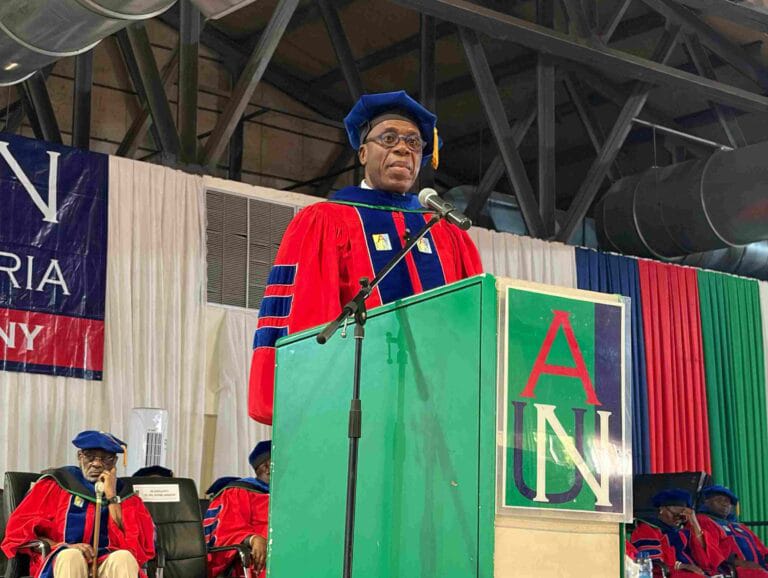
Atiku said the American University of Nigeria (AUN) was strategically positioned to help the country embrace the new technological era and prepare young people for the changing demands of the global economy.
He made the call in an address titled “The Future We Choose: Human Capital, Artificial Intelligence, and Nigeria’s Renewal,” delivered during the university’s Founders’ Day celebration.
The former Vice-President argued that Nigeria’s major development challenge was not a shortage of talent but the failure to adequately develop and utilise the country’s enormous human potential.
He warned that the country must make a deliberate choice between transforming its growing population into a skilled and productive workforce or allowing demographic expansion to worsen unemployment, insecurity, poverty and social frustration.
According to him, the quality of human capital, rather than the abundance of natural resources, will ultimately determine Nigeria’s economic competitiveness and national prosperity.
While acknowledging the opportunities offered by emerging technologies, Atiku cautioned that they could widen inequality if access remained limited to privileged groups or if young Africans continued to consume technology rather than create and innovate.
He therefore advocated an education system that prepares young Nigerians not only to use emerging technologies but also to understand, improve, regulate and apply them to the country’s developmental challenges.
He identified agriculture, education, healthcare, electricity, clean water supply and small-business development as sectors that could benefit significantly from technological innovation.
Atiku also called for a fundamental shift in the country’s educational philosophy, stressing that academic certificates alone were no longer sufficient to meet the demands of the modern world.
He identified five essential qualities that education should develop: strong foundational knowledge, practical competence, entrepreneurial confidence, ethical judgment and social responsibility.
The former Vice-President challenged universities to move beyond traditional teaching and examination systems to become centres of innovation, research, entrepreneurship, civic responsibility and economic transformation.
He particularly urged AUN to strengthen its commitment to the development of North-Eastern Nigeria, noting that its location provided an opportunity to demonstrate that academic excellence could thrive even in challenging environments.
He also emphasised the need to expand entrepreneurship, technology, research, community engagement and leadership development while ensuring that financially disadvantaged but talented students were not denied access to quality education.
On national development, Atiku called for renewed cooperation among government, the private sector, universities, the diaspora and citizens to strengthen human capital development.
He said government must provide reliable electricity, affordable internet connectivity, security, transparent regulations and sustained investment in education and research.
He urged the private sector to invest in skills development, internships, technology transfer and local innovation, while calling on Nigerians in the diaspora to contribute knowledge, mentorship, capital and international networks.
Atiku also challenged young Nigerians to embrace lifelong learning and technological change, stressing that success should be measured not only by personal income or positions attained but also by the problems individuals solve and their contributions to society.
Another major highlight of the Founders’ Day celebration was a lecture delivered by Professor Obiora Okonkwo, OFR, titled “Purposeful Education and the 21st-Century University: Leadership, Innovation and Social Responsibility.”
The lecture examined the role of purposeful education and the responsibilities of contemporary universities in addressing Nigeria’s and Africa’s developmental challenges.
Okonkwo also paid tribute to Atiku for establishing and sustaining AUN, describing him as a visionary institution builder whose commitment to education extended beyond the conventional responsibilities of a university founder.
He highlighted the university’s non-profit status, Atiku’s financial support over nearly two decades, the significant number of students benefiting from full scholarships and its relatively affordable fees despite offering international-standard teaching and infrastructure.
The professor said Atiku’s continued support for major institutional initiatives demonstrated his commitment to positioning AUN as a leading development-oriented university in Africa.
He described investment in higher education as a long-term commitment to national advancement and the development of a more enlightened and productive society.
“Your Excellency, Sir, thank you for demonstrating, in the most practical way, that education, particularly higher education, is a transgenerational investment, not just in national advancement but also in the cultivation of a more enlightened, productive and qualitatively transformed humanity,” Okonkwo said.
He also celebrated Atiku’s forthcoming 80th birthday on November 25, describing his contributions to humanity as invaluable.
On the broader responsibilities of universities, Okonkwo argued that education must go beyond academic qualifications to develop human and social capabilities.
He maintained that the relevance of a university should not be measured solely by the number of certificates awarded, research publications produced or institutional reputation, but also by the problems it helps solve and the opportunities it creates for society.
He warned against an educational system that prioritises qualifications without adequately developing graduates’ ability to think critically, solve problems, communicate effectively, collaborate and exercise sound judgment.
According to him, purposeful education should produce individuals capable of thinking clearly, acting competently, creating value and recognising responsibilities beyond personal advancement.
Okonkwo further stressed that international academic standards should complement, rather than compete with, a university’s responsibility to address national and regional development challenges, citing AUN as an example.


