





By Abubakar Rabilu
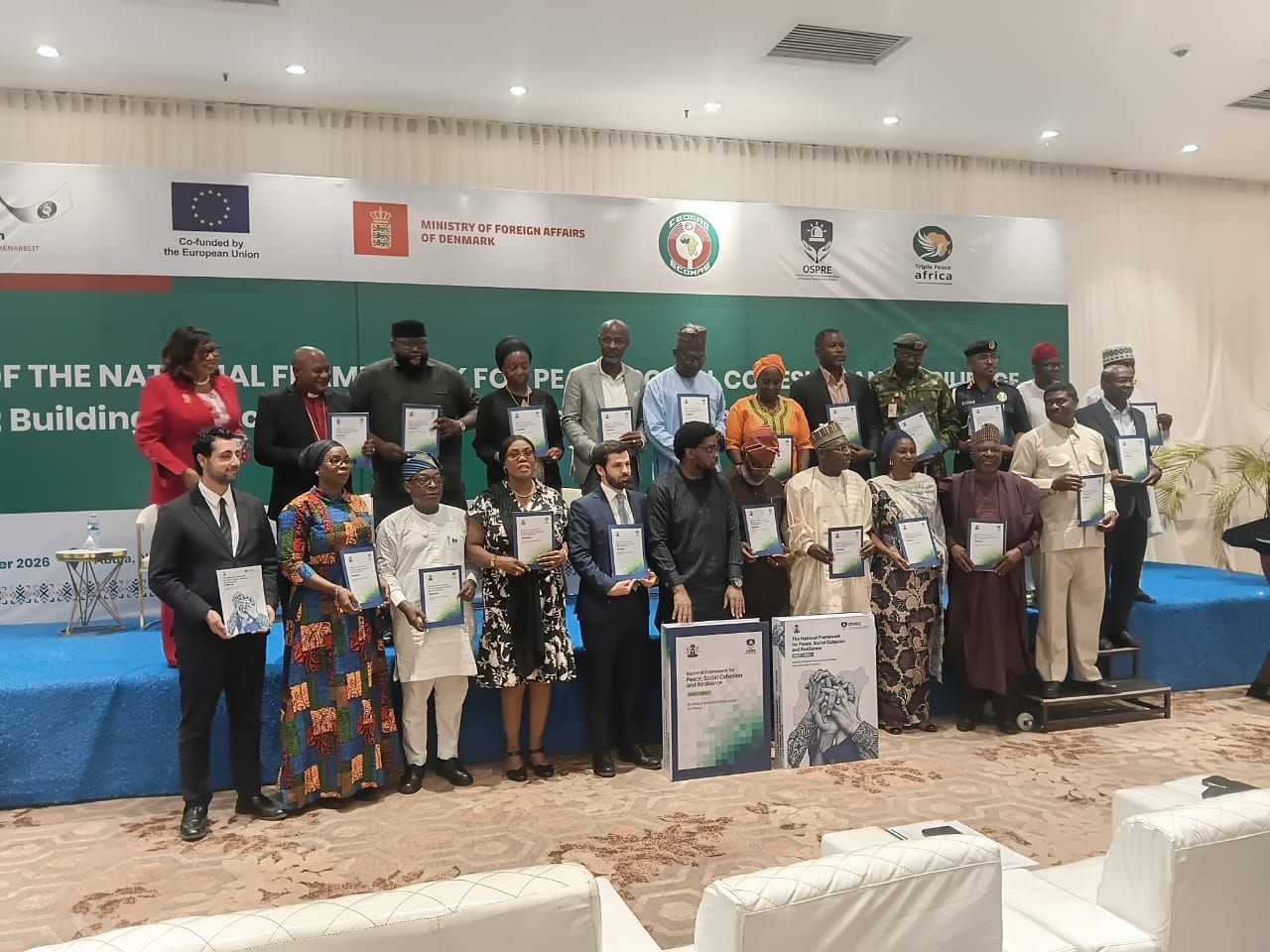
The Federal Government has unveiled a National Framework for Peace, Social Cohesion and Resilience as part of efforts to address the root causes of insecurity, prevent conflicts and promote peaceful coexistence across the country.
The framework is expected to provide a coordinated national approach to peacebuilding, conflict prevention, dispute resolution and sustainable development through stronger collaboration among government institutions, security agencies and communities.
The initiative was developed by the Office for Strategic Preparedness and Resilience (OSPRE), in collaboration with Triple Peace Africa, with support from the European Union (EU) and the German development agency, GIZ.
The launch attracted senior government officials, representatives of the ECOWAS Commission, security agencies, state peace commissions, civil society organisations and development partners.
Speaking at the event, the Director-General of OSPRE, Chris Ngwodo, said the framework was the product of nationwide consultations involving government institutions and other stakeholders to establish a shared understanding of Nigeria’s peacebuilding priorities.
He explained that the initiative, which began in 2025 as a review of the existing National Peace Policy, had evolved into a broader framework designed to address emerging security and governance challenges.
Delivering the keynote address, the Special Adviser to the President on Homeland Security, Major General Adeyinka Famadewa (retd.), said military operations alone could not resolve the underlying causes of insecurity.
He stressed that sustainable security depended on strong institutions, responsive governance, public trust and community-based mechanisms for resolving disputes.
According to him, the framework would bridge the gap between security operations and civilian-led peacebuilding while improving coordination among the federal, state and local governments.
He added that the initiative would complement the National Threat Assessment and Strategic Defence Operations Plan, in line with President Bola Tinubu’s whole-of-government and whole-of-society approach to national security.
Also speaking, the Minister of Humanitarian Affairs and Poverty Reduction, Dr Bernard M. Doro, said humanitarian challenges, including displacement and the disruption of livelihoods, could not be sustainably addressed without tackling the root causes of insecurity.
Similarly, the Director-General of the National Boundary Commission, Surveyor Adamu Adaji, called for stronger collaboration among border communities, security agencies and government institutions to prevent conflicts arising from competition over natural resources and cross-border activities.
The Special Assistant to the President on Humanitarian Affairs and Development Partners in the Office of the Vice President, Mrs Inna Audu, emphasised the need to integrate peacebuilding into national development planning and humanitarian interventions.
In his remarks, the Executive Director of Triple Peace Africa, Dr Paul Nyulaku, described the framework as the outcome of extensive consultations involving government institutions, peacebuilding practitioners and communities across Nigeria.
The unveiling marks the beginning of a new phase of institutional adoption and coordinated implementation, aimed at making peacebuilding an integral part of Nigeria’s governance, security and development architecture.


