





By Christiana Gokyo, Jos
The Plateau State Government says it has so far committed more than N2.6 billion in counterpart funding towards the successful implementation of the Plateau State Urban Water Supply Project.
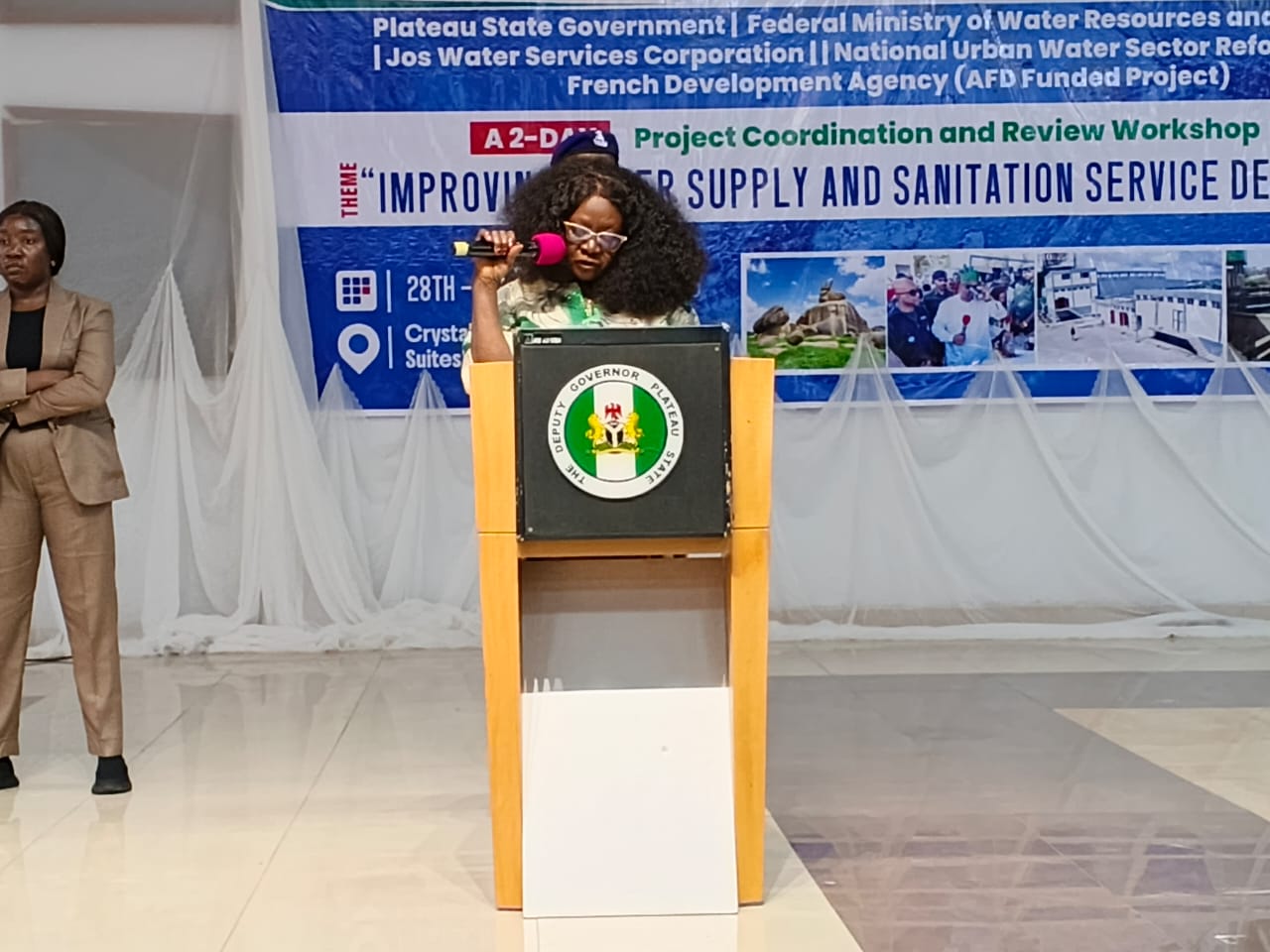
Governor Caleb Manasseh Mutfwang disclosed this on Monday while declaring open a two-day Project Coordination and Review Workshop organised by the Plateau State Government, the Federal Ministry of Water Resources and Sanitation, Jos Water Services Corporation and other stakeholders under the National Urban Water Sector Reform Project and Agence Française de Développement (AFD)-funded projects.
The workshop is being held at Crispan Hotel, Jos.
The Governor, who was represented by his Deputy, Hon. Mrs Josephine Piyo, said the workshop provided an important platform for strategic policy, technical expertise and practical implementation to converge in addressing challenges confronting Nigeria’s urban water sector.
According to him, water is more than a public utility, describing it as the lifeblood of economic productivity, public health, human dignity and social stability.
“As our cities continue to grow rapidly, the pressure on existing water infrastructure and municipal supply networks is becoming increasingly intense.
“This reality demands that we move beyond conventional approaches and embrace reforms that are strategic, sustainable, accountable and responsive to the realities of our growing urban populations,” he said.
“As leaders and public administrators, our responsibility is not simply to provide infrastructure, but to build systems that can deliver efficiently, consistently and sustainably over the long term.”
Mutfwang said his administration considered water security a fundamental pillar of modern governance and human development, adding that the government was committed to strengthening the institutions, infrastructure and systems required to expand access to potable water across the state.
He said that through the Jos Water Services Corporation, in collaboration with relevant ministries, departments and agencies, the government had continued to pursue interventions aimed at improving water production, treatment and distribution.
“These interventions include the expansion of municipal reticulation networks across the state, the rehabilitation of the Yelwa Water Treatment Plant, the reticulation of the Mangu Regional Water Scheme, and the rehabilitation and construction of water infrastructure in Bokkos, Langtang North, Langtang South and Wase,” he explained.
The Governor further said the government was also rehabilitating two major water treatment facilities—the Yakubu Gowon Water Treatment Plant and the Laminga Water Treatment Plant—with support from the AFD.
According to him, the interventions reflected the government’s conviction that expanding access to potable water required not only substantial capital investment, but also strong institutions, sound management, effective regulation and sustained administrative discipline.
“This significant commitment demonstrates our determination to ensure that development interventions translate into tangible improvements in the lives of our citizens,” he said.
Mutfwang described the review workshop as more than a routine administrative exercise, saying it provided a platform for accountability, peer learning, technical coordination, problem-solving and strategic realignment.
He said participants would use the two-day workshop to assess project progress, examine implementation challenges, identify bottlenecks, share experiences and develop practical solutions to accelerate delivery.
The Governor urged State Project Implementation Units and other stakeholders to engage in the deliberations with openness and a strong commitment to achieving results.
He also urged them to critically examine performance indicators, identify areas requiring urgent intervention, address operational and administrative delays, and develop realistic strategies to ensure that every naira and dollar committed to the water sector delivers maximum value to citizens.
According to him, the success of any reform programme should ultimately be measured by its impact on the lives of citizens rather than by the number of meetings held or reports produced.
The Governor appreciated the AFD for its sustained technical and financial support, which he said had contributed significantly to sector-wide reforms and infrastructure development across participating states.
He also appealed to the AFD to consider simplifying administrative processes and expediting the issuance of No Objection approvals for deserving project components.
He said timely approvals were critical to enabling states to meet implementation deadlines, minimise avoidable delays and sustain the momentum of project delivery.
Mutfwang urged participants to approach the workshop not merely as an obligation but as an opportunity to shape the future of urban water supply in Nigeria.
He reiterated that addressing the challenges of urban water supply required collective responsibility, sustained investment, strong institutions and unwavering political commitment.
Federal Government Commends Plateau’s Counterpart Funding
The representative of the Minister of Water Resources and Sanitation, Engr. Kasim Mohammed Nafi’u, said the workshop was important because it allowed the four participating states to assess progress, deliberate on challenges and chart a way forward towards achieving the project’s development objectives.
According to him, the Plateau State Government had committed N2.6 billion as counterpart funding, but additional funds would be required to meet tax and compensation obligations and avoid leaving outstanding debts after the completion of the projects.
“After the tea break, we will commence the technical aspect where all four states will make presentations. We tell ourselves the plain truth. There is no politics in it. We have technical experts and administrative people here. Everybody is here,” Nafi’u said.
Plateau Reviews AFD-Funded Water Projects
The Plateau State Commissioner for Water Resources and Energy, Hon. Bashir Lawandi Dati, thanked Governor Mutfwang for approving the hosting of the workshop.
Dati disclosed that the state was implementing AFD-funded projects, including the rehabilitation of the Yakubu Gowon and Laminga water treatment plants and reticulation within the Greater Jos Master Plan.
“This workshop brings all implementing states together to review performance under the AFD project. It shows His Excellency’s commitment to ensuring Plateau people have access to clean and safe water,” Dati said.
He further stated that the project, which commenced about four years ago and was initially scheduled for completion in December 2026, had now been extended by two years to 2028.
Dati said the state government, through the Ministry of Water Resources, had made significant counterpart funding contributions towards the project.
He explained that the state had paid N610 million in an earlier contribution and recently paid an additional N2 billion in 2026.
He added that the state government was expecting further funding from Governor Mutfwang to support the project, stressing that the Governor remained committed to providing sustainable and safe drinking water to the people of Plateau State.
Dati said the reticulation component of the project would take 18 months to complete.
“With this extension, we will be able to finish the project completely. After this project, water scarcity in Plateau will be history,” he said.


