




By Lamara Garba
There are people who speak about changing society, and there are those who quietly roll up their sleeves and get to work. There are institutions that make promises about human development, and there are organisations that turn those promises into opportunities. In the long journey of nation building, the difference between the two is often the difference between words and deeds, between aspiration and achievement, between talking the talk and walking the talk.
The Women Farmers Advancement Network (WOFAN), under the leadership of its Director, Dr Salamatu Garba, belongs unmistakably to the second category.
Her story is not merely about an organisation implementing development programmes across communities.
It is also a story about a woman who understands that the most enduring investment any society can make is an investment in people, knowledge and human capacity.
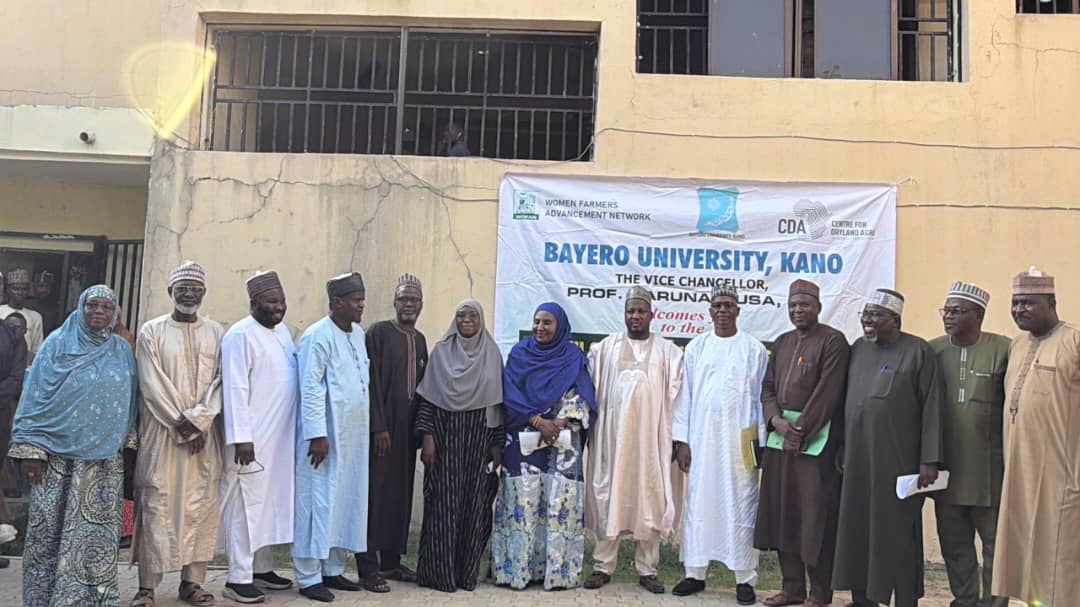
That philosophy has found a remarkable expression in the relationship between WOFAN and Bayero University, Kano.
Over the years, the organisation has supported several dozens of members of staff of the University, both teaching and non teaching, providing opportunities for them to develop their careers, acquire new knowledge, strengthen their intellectual capacity and contribute more meaningfully to society.
This may appear, at first glance, to be another institutional intervention. But beneath the surface lies something much deeper: a deliberate belief that education is not an expense but an investment; that knowledge is not a private possession but a social resource; and that when one person acquires the capacity to do more, an entire community ultimately stands to benefit.
Dr Salamatu Garba appears to understand this timeless truth: when you light another person’s candle, you do not make your own light dim. Rather, you create a brighter environment in which everyone can see more clearly.
For an academic institution such as Bayero University, Kano, where teaching, research and community service constitute the foundation of its mission, capacity building is not a luxury. It is oxygen.
Universities thrive when their people are continually exposed to new ideas, new technologies, new methodologies and new intellectual frontiers. A university cannot remain relevant by merely preserving yesterday’s knowledge. It must constantly prepare its people for tomorrow.
It is against this background that WOFAN’s intervention in the development of university staff deserves recognition.
The significance goes beyond the number of beneficiaries. Every member of staff supported represents a potential multiplier. A lecturer who acquires additional knowledge transfers it to students.
A researcher who develops new competence may generate ideas capable of influencing policy or solving community problems. A non teaching staff member who receives professional development can improve institutional efficiency and service delivery. In this sense, the impact of capacity building travels far beyond the individual beneficiary.
It is the old African philosophy of “I am because we are” expressed through modern institutional development.
And this is where Dr Salamatu Garba’s leadership philosophy becomes particularly compelling.
Her approach suggests that development is not about standing at the centre of attention; it is about creating opportunities for others to stand taller.
It is not about being the loudest voice in the room, but about ensuring that more voices are equipped to speak with knowledge, confidence and competence.
There is a political dimension to such philanthropy, but not necessarily the politics of party colours or electoral contests. It is the higher politics of social investment: the politics of empowering citizens, strengthening institutions and expanding the frontiers of opportunity.
In a country where conversations about education often revolve around funding gaps, infrastructure deficits, unemployment and the migration of talented young people, interventions that strengthen the human beings behind the institutions deserve serious attention.
Nigeria cannot build a knowledge economy with buildings alone. Laboratories, libraries and lecture theatres are important, but the most valuable asset of any educational institution remains the quality, capacity and imagination of its people.
This is why WOFAN’s partnership with members of the Bayero University community carries a message larger than the immediate beneficiaries.
It says that development must begin with people.
It says that the classroom must not be disconnected from society.
It says that knowledge must be given the opportunity to travel from the university to the marketplace, the farm, the community, the public institution and the policy arena.
And it says that those who have the capacity to help others rise have a moral responsibility to do so.
Dr Salamatu Garba has, through this commitment, demonstrated the spirit of a good neighbour. A good neighbour does not wait for a problem to knock loudly before offering a helping hand.
A good neighbour notices potential, recognises need and responds with compassion. A good neighbour understands that the prosperity of one household contributes to the peace and prosperity of the entire neighbourhood.
There is a beautiful African wisdom which says that a person does not become great by pulling others down; greatness is measured by how many people rise because of one’s presence.
This is perhaps the most appropriate lens through which to view the WOFAN Director’s commitment to educational and professional development.
The Amazon, as she is widely regarded, has chosen to spend part of her institutional resources developing other people. In doing so, she is building a legacy that cannot be measured only in financial figures.
Her real balance sheet is written in human lives, professional achievements, new ideas, improved competencies and the countless beneficiaries who may themselves go on to touch other lives.
That is the beauty of investment in knowledge: it multiplies.
Money spent on a physical structure may produce a building. Money invested in human capacity can produce teachers, researchers, administrators, innovators, entrepreneurs, policy thinkers and future leaders.
The return is therefore not merely economic. It is intellectual, social, institutional and ultimately national.
For Bayero University, Kano, this support also reflects the importance of strong relationships between universities and development organisations.
The university is not an island. It exists within a wider ecosystem of government, industry, civil society, development agencies and communities. When these institutions work together, the boundaries of what is possible become wider.
WOFAN’s engagement demonstrates that the development organisation can look beyond its immediate programme beneficiaries and recognise the university as a strategic partner in the production and dissemination of knowledge.
That is an important model for Nigeria.
Our universities need partners who believe in them. Our researchers need opportunities to sharpen their tools.
Our administrators need exposure to contemporary practices. Our young people need mentors and institutions that can prepare them for a rapidly changing world.
And our development organisations need universities capable of transforming knowledge into solutions.
The circle is complete when these interests meet.
Perhaps the most inspiring aspect of Dr Salamatu Garba’s intervention is the philosophy behind it. It reflects an understanding that societal progress is rarely achieved through one dramatic gesture. It is built brick by brick, person by person, opportunity by opportunity.
Little drops of water make the mighty ocean.
One staff member supported today may train hundreds of students tomorrow. One researcher empowered today may develop an intervention that improves thousands of lives. One administrator given an opportunity to acquire new skills may help an institution serve tens of thousands of people more effectively.
That is how seemingly modest interventions become instruments of transformation.
In this age of public relations, where institutions sometimes announce more than they accomplish, WOFAN offers a refreshing reminder that credibility is earned through action. The most convincing press release is often not a document. It is the evidence left behind in the lives of people who have benefited.
WOFAN has, over time, created such evidence.
Its support for university staff speaks to a leadership style that appears to place people at the heart of development. It is a philosophy that does not merely ask, “What can we achieve?” but also asks, “Who can we help become capable of achieving more?”
That distinction is profound.
For Dr Salamatu Garba, the work therefore goes beyond managing an organisation. It is about cultivating possibilities. It is about making the road easier for others to travel. It is about understanding that society advances when its people are given the tools to advance themselves.
And perhaps this is the essence of Walk the Talk.
To talk about education is easy. To commit resources to education is different.
To speak about human capital development is easy. To invest in the people who carry institutions forward requires conviction.
To celebrate knowledge is easy. To create opportunities for people to acquire more of it requires sacrifice.
WOFAN has chosen the harder path.
It has chosen to walk.
As Nigeria searches for pathways out of unemployment, poverty, institutional weakness and underdevelopment, stories such as this deserve to be told because they offer a different narrative about what is possible when compassion meets capacity, when leadership meets responsibility and when resources are directed towards human beings.
The story of WOFAN and Bayero University is therefore not simply a story of institutional support. It is a story about the philosophy of giving, the politics of development and the poetry of human possibility.
Dr Salamatu Garba’s intervention reminds us that leadership is not always found behind a podium. Sometimes it is found in the quiet decision to pay for someone’s training, support someone’s academic journey, strengthen someone’s professional capacity or open a door that might otherwise have remained closed.
And when that door opens, the beneficiary may not be the only one who walks through it. Students, families, communities, institutions and future generations may follow.
That is why the work matters.
That is why the gesture is bigger than the grant.
That is why the investment is bigger than the individual.
And that is why WOFAN’s relationship with Bayero University deserves to be seen as a model of purposeful partnership.
In the final analysis, societies are remembered not only for the monuments they build, but for the people they empower.
Dr Salamatu Garba appears to understand this.
She has chosen to invest in people.
She has chosen to strengthen knowledge.
She has chosen to nurture capacity.
She has chosen to make others happy by helping them become better equipped to fulfil their potential.
And in doing so, she has demonstrated a simple but powerful truth: the greatest measure of what we possess is not what we keep, but what we help others become.
That is the philosophy behind the walk.
That is the meaning behind the talk.
And that is the story of WOFAN: Walk the Talk.
Lamara Garba, is Director, Public Affairs at Bayero University, Kano