



By Abdu Abdullahi
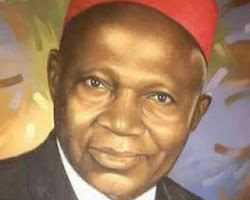
The late erudite statesman Yusuf Maitama Sule, Dan Masanin Kano articulated Malam Aminu Kano’s articles of moral faith with an elevated style of nostalgia. 43 years after Malam Aminu’s painful death on Sunday, 17 April 1983, his articles of moral faith are still resonating as the solid blocks of foundational politics.
They are the quintessential catalyst for an effective political leadership and deepening democracy.
According to Sule’s inspiring and reflective tribute, “Malam went into politics to give not to take. He said in open what he accepted in secret. He never lied. He was honest. He was incorruptible. He said what he believed and had a disciplined mind. He was a man of integrity- both moral and financial. He kept asking himself, as did J.F.Kennedy, what he could do for his country, not what his country could do for him.”
Going by the low level of political integrity of an average Nigerian, a foreign diplomat aptly celebrated Aminu Kano as ‘ too good to be a Nigerian.’ If this was the greatest moral achievement of Aminu Kano, how would you rate our current leaders’ moral and political deficiencies and their ruinous effects on national development? Perhaps, Malam could have been entrusted with the responsibility of political leadership if it were in other countries where his indefatigable moral character would not have been a wasted asset.
Interestingly, Aminu Kano was metaphorically described as’ real’ in every sense of the word by the late Professor Chinua Achebe. The late revered literary icon appreciated Aminu Kano as a practical politician whose profound philosophy was making Nigeria a better place for living. At a point, Aminu explained that his stay in England hardened his soul in elevating truth, freedom and above all human rights. This was a turning point in his frantic efforts searching for the true reformation of society to uplift humanity.
The social environment (North) of Aminu Kano’s upbringing was and is still conservatively stubborn. The only political faith that predominantly defines the North is opportunism. In essence, Aminu Kano’s persistent and unwavering struggles were meant for primarily liberating the North from socioeconomic and political ills. Thus, he was the best teacher of politics shaped by esteemed purpose of morality.
When he launched his gallant fights for the emancipation of the masses, he fought simultaneously against two forces, the colonial power and its local allies. Later, Aminu Kano strongly and eventually believed in organizing political party as the only means the oppressed can gain freedom, liberty and dignified living. He started his political career with the formation of the radical Northern Progressive Elements Union (NEPU) during the First Republic. The party metamorphosed into a modified version which was renamed as the Peoples Redemption Party (PRP) during the ill-fated Second Republic.
To fulfill the great task of redeeming the masses from injustices, he denied himself the comfort of life and other non essentials which often waste the human spirit. For instance, he cited that pleasures of the flesh would not allow him to realize his full potentials as a political warrior who had so many hurdles to cross in the service of humanity. Before his passing away, Nigeria benefited from his politics drawn from a messianic proportion by succumbing to philosophical consistency. He lived and suffered for his unbreakable philosophy of enthroning a masses oriented government.
Aminu’s best friends were the talakawa. Their pains were his pains. Their joy was his joy. He never betrayed their collective aspirations. He shared with them what many northern elites could not. He lived for the masses at a time when they were abandoned and oppressed by repressive systems and institutions. His vision was the triumph of the masses against the established order so that poverty might have given way to comfort, privilege to equality and political, economic and social slavery to freedom.
Aminu Kano’s popular voice of redemption started to rent the air. It occupied the political space to usher in a new beginning. Those articles of moral faith were supportive of his political activities and consequently reformed his political vision to be seen as larger than life. The American author, Alan Feinstein, described Malam as ‘African Revolutionary’ because he believed that his moral faith had the potency of conveying universal messages of order and stability.
While Aminu Kano was not greedy to acquire power, fame and influence, he was too ambitious to emancipate the masses from the shackles of political, social and economic injustices. His articles of moral faith compelled him to lead by example. He was a leader who created many leaders for a purpose, instead of creating passive followers without a purpose. Were Abubakar Rimi, Balarabe Musa, Sule Lamido, S.G. Ikoku not some of those leaders?
At the end of his fruitful life built by articles of moral faith, he left behind an old television set, an old Peugeot 504 car, N114, two sets of simple clothes and a moderate house. This was strange because he served as the Federal Finance Commissioner during the regime of General Yakubu Gowon.
In a nutshell, can we bring back Aminu Kano’s articles of moral faith to save our political domain from moral and total collapse?
Abdullahi can be reached via:
aaringim68@gmail.com or
07036207998.