




By Abdulaziz Ismail
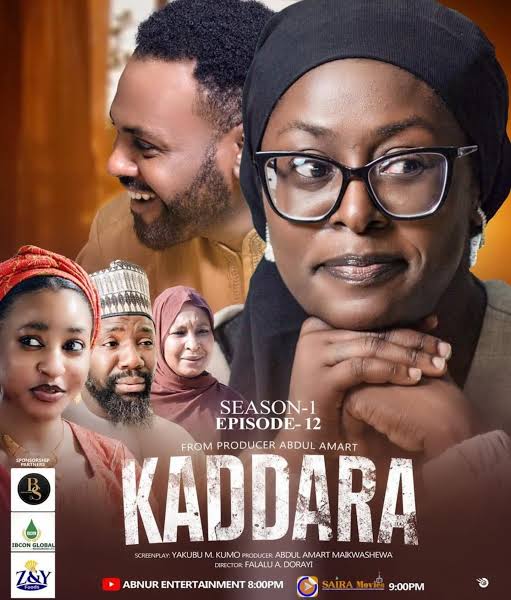
Kaddara has finally drawn its curtain, but its impact will linger long after the closing scene.
Few television productions have succeeded in entertaining audiences while provoking such meaningful conversations about marriage, family, faith, communication, and personal responsibility.
Episode 13, the season finale, was not merely an ending; it was a powerful reminder that great storytelling can educate as much as it entertains.
One of the most remarkable moments of the episode was Maimuna’s speech while introducing Abdul.
For weeks, viewers had believed that Abdul and Maimuna were foster siblings because the story established that they had suckled from the same breast.
That revelation effectively ruled Abdul out as a potential husband in the minds of many viewers.
The writers, however, masterfully challenged that assumption, delivering one of the most memorable twists of the series.
Beyond the surprise, Maimuna’s message carried an even deeper lesson. She spoke about society’s tendency to judge people who remain unmarried or who are divorced without understanding the circumstances behind their choices.
Too often, society labels individuals based on assumptions rather than facts, forgetting that every person’s journey is unique.
Someone else’s experience does not have to become another person’s reality. It was one of the most mature and thought-provoking messages delivered throughout the series.
Another important theme explored in the finale was intimacy compatibility in marriage, a subject many communities avoid discussing despite its undeniable importance.
Kaddara approached this sensitive issue with maturity and honesty, demonstrating that silence around difficult topics often creates greater problems.
Through the marriage of Maimuna and Jamil, viewers witnessed how incompatibility in intimacy affected both spouses emotionally.
Maimuna became vulnerable and emotionally unsettled, while Jamil struggled under the pressure of forcing himself into intimacy despite having different emotional and physical needs.
Their marriage was built on love, mutual respect, and peace, yet this single unresolved issue gradually weakened their relationship until separation became inevitable.
The series also acknowledged that people differ in their levels of intimacy and emotional expression.
While discussing such matters before marriage may not eliminate every challenge, honest conversations can help couples understand each other better, manage expectations, and make more informed decisions before embarking on a lifelong commitment.
Perhaps that is one of the greatest strengths of Kaddara. It refused to reduce marriage to romance alone. Instead, it presented marriage as a complex partnership that requires communication, understanding, patience, and continuous learning.
The finale itself was an emotional roller coaster. The separation of Maimuna and Jamil left many viewers heartbroken, while the unexpected ending reminded audiences that life does not always follow predictable paths.
Credit must go to everyone behind the production. The writing was deliberate, the directing thoughtful, and the performances convincing.
Every member of the cast brought authenticity to their roles, making audiences laugh, cry, celebrate, become frustrated, and reflect.
When a drama consistently generates meaningful public conversations every week, it has undoubtedly achieved something beyond entertainment.
Perhaps the most rewarding outcome of Kaddara has been the discussions it inspired.
Every episode became an opportunity to examine issues such as marriage, parenting, accountability, communication, faith, and personal growth.
Viewers often disagreed, yet many of those conversations remained respectful, thoughtful, and educational.
That is precisely what storytelling should accomplish. Rather than dividing people, it should encourage dialogue, challenge assumptions, and broaden perspectives.
Healthy disagreement enriches public discourse, provided it is expressed with respect rather than personal attacks or insults.
The success of Kaddara is therefore not measured solely by its ratings or popularity, but by its ability to spark conversations that extend beyond the television screen into homes and communities.
The writer, Yakubu M. Kumo, director Falalu A. Dorayi, producer Abdul Amart, the cast, and the entire production crew deserve commendation for delivering a story that entertained while provoking reflection.
As the series comes to an end, one can only hope that future productions will continue this tradition of using drama not merely as entertainment but as a vehicle for education, dialogue, and social reflection.
Kaddara has shown that meaningful storytelling remains one of the most powerful tools for shaping conversations and encouraging society to confront issues that are often left unspoken.
Abdulaziz Ismail reviews kannywood films and can be reached via ilileecakes@gmail.com