





From Muawuya Bala Idris, Katsina
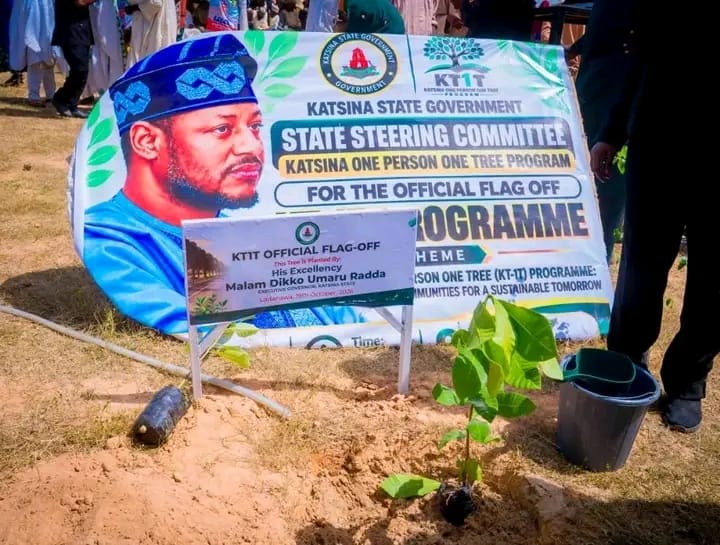
The Katsina State Government has reaffirmed its commitment to environmental protection, targeting the planting of 11 million trees across the state by 2031 under the Katsina One Person, One Tree Initiative.
The initiative aims to plant two million trees in 2026 across the state’s 34 local government areas as part of efforts to combat desertification, mitigate climate change and strengthen food security.
Governor Dikko Umaru Radda disclosed this during the flag-off of the Katsina One Person, One Tree Initiative at Larabawa, in Kaɗanɗani Ward of Rimi Local Government Area.
He said the initiative was built around the principle of “one person, one tree, and one responsibility,” urging residents to take ownership of environmental protection.
According to the governor, tree planting would help protect farms from wind erosion, conserve soil, restore soil fertility, improve food production and increase farmers’ incomes.
He also highlighted the state’s climate governance measures, including the approval of a climate change policy, the establishment of a State Climate Change Council and the introduction of climate expenditure tracking across ministries, departments, agencies and local government councils.
Radda called on residents, traditional institutions, farmers and other stakeholders to support the initiative to ensure the survival of planted trees and the achievement of the state’s long-term environmental targets.
Representing the Minister of Environment, Malam Balarabe Abbas, the Director-General of the Greenwall Agency said the Federal Government would encourage state governors across Nigeria to adopt the initiative introduced by the Katsina State Government.
He noted that climate change, environmental degradation and desertification posed significant threats to ecological security and the resilience of communities across Nigeria and Africa.
According to him, previous tree-planting campaigns often failed to achieve lasting results because of poor seedling survival rates, inadequate long-term forestry planning and limited community ownership.
He explained that the current initiative offered a more sustainable approach by establishing a governance framework that promotes participation at state and local government levels, political commitment, effective monitoring and the long-term survival of planted trees.
Earlier, the Special Adviser on Climate Change, Professor Al’amin Mohammed, said the programme, initiated by Governor Radda, was designed to mobilise individuals and communities to participate in tree planting, ecosystem restoration and efforts to mitigate the effects of climate change.
He noted that the governor had prioritised environmental protection and sustainable natural resource management.
These efforts include the establishment of the Katsina State Secretariat on Climate Change and the State Climate Change Council, chaired by the governor, to support the implementation of the administration’s climate action strategies.


