





From Atiku Sarki, Abuja
The Federal Government, in partnership with the European Union (EU) and the World Health Organization (WHO), has launched a €4.2 million programme aimed at strengthening Nigeria’s public health institutions and improving preparedness for disease outbreaks.
The programme, known as the EU Support to Public Health Institutes in Nigeria (EU SPIN), will be implemented by the WHO in collaboration with the Federal Ministry of Health and Social Welfare over a four-year period.
Funded by the European Union, the initiative is designed to enhance information sharing, improve outbreak response, and reduce poor health outcomes across the 36 states and the Federal Capital Territory (FCT), Abuja.
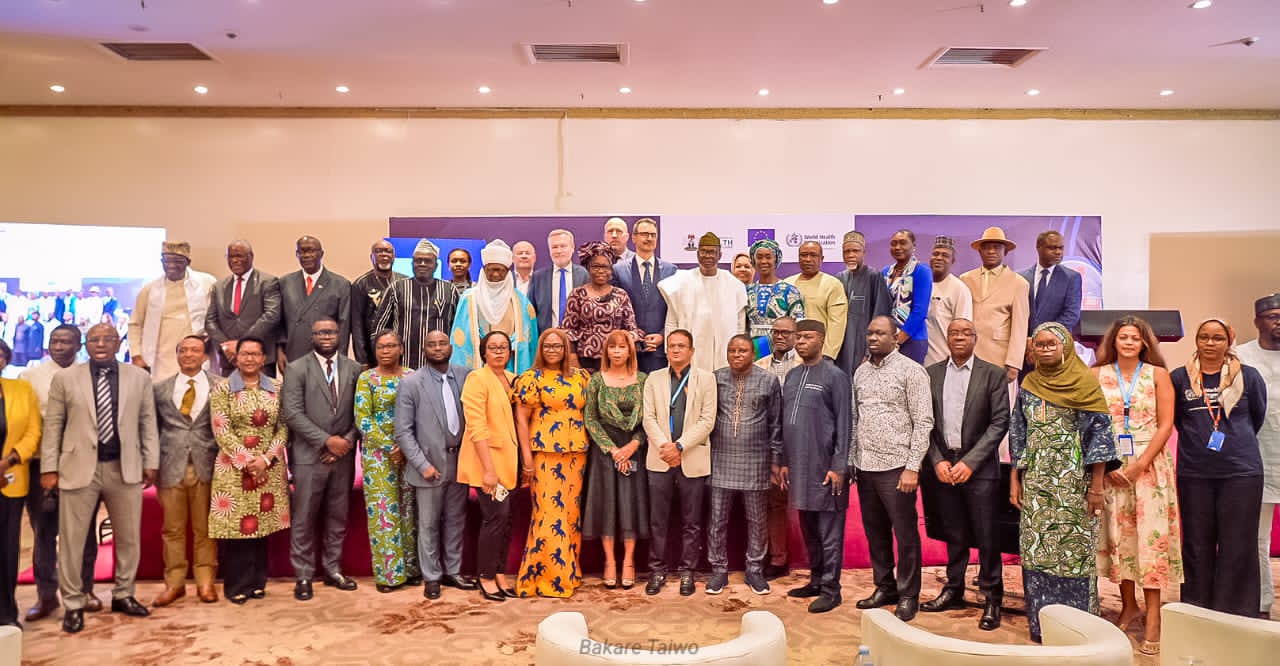
The programme was officially launched on Monday in Abuja, bringing together officials from federal and state governments, development partners, civil society organisations, traditional rulers, media practitioners, and other stakeholders.
Speaking at the ceremony, the Minister of State for Health and Social Welfare, Dr. Iziaq Adekunle Salako, described the initiative as a major boost to Nigeria’s healthcare delivery system.
According to him, the programme will strengthen public health institutions and improve the well-being of Nigerians, particularly vulnerable populations.
“This initiative is designed to strengthen our health institutions, and it is truly a welcome development. It will improve the well-being of Nigerians, especially our vulnerable populations,” he said.
Salako appreciated the European Union and the WHO for supporting Nigeria’s health sector in line with the Renewed Hope Agenda of President Bola Ahmed Tinubu’s administration.
He noted that Nigeria continues to face repeated disease outbreaks alongside a growing burden of non-communicable diseases such as hypertension and diabetes, placing increasing pressure on healthcare institutions.
“The Federal Government and its partners have today taken a major step towards strengthening the capacity of Nigeria’s healthcare delivery system to deal with disease outbreaks,” he added.
The minister explained that the programme aims to strengthen the core functions of selected public health institutions to enable earlier detection of outbreaks, faster information sharing, and reduced health risks nationwide.
In his remarks, the European Union Ambassador to Nigeria, Gautier Mignot, said the initiative reflects the EU’s commitment to supporting strong and digitally enabled public health institutions in Nigeria.
“Through EU SPIN, the European Union is investing in strong, digitally enabled public health institutions in Nigeria.
“This partnership reflects our shared commitment to health security and sustainable systems strengthening,” he said.
He added that public health workers across all levels would benefit from improved coordination, better tools, and enhanced skills, leading to better health outcomes for women, children, the elderly, persons with disabilities, internally displaced persons, and other vulnerable groups.
Also speaking, the WHO Representative in Nigeria, Dr. Pavel Ursu, said the project would improve coordination, skills, and digital tools needed to protect lives and promote healthier communities.
By 2028, the programme is expected to improve inter-institutional coordination, establish clearer operational roles, and strengthen reliable public health data systems across federal, state, and local government levels.
According to WHO statistics, non-communicable diseases account for about 27 per cent of deaths in Nigeria, while malaria contributes nearly 30 per cent of global malaria deaths. The country also continues to battle recurrent outbreaks of cholera, diphtheria, Lassa fever, meningitis, and Mpox.
To address these challenges, the EU SPIN initiative will support real-time data sharing systems, strengthen collaboration among public health institutions, enhance workforce digital skills, and train frontline health workers, with a target of 75 per cent of staff trained.
The programme will also link public health services more effectively with primary healthcare and local communities.
In their goodwill messages, Founder and CEO of Wellbeing Foundation Africa, Toyin Saraki; the Emir of Shonga, Dr. Haliru Ndanusa Yahaya; and the President of the Association of Public Health Physicians of Nigeria (APHPN), Dr. Terfa Kene, commended the EU, WHO, and the Federal Government for their efforts to strengthen Nigeria’s public health institutions at both national and sub-national levels.


