





By Christiana Gokyo, Jos
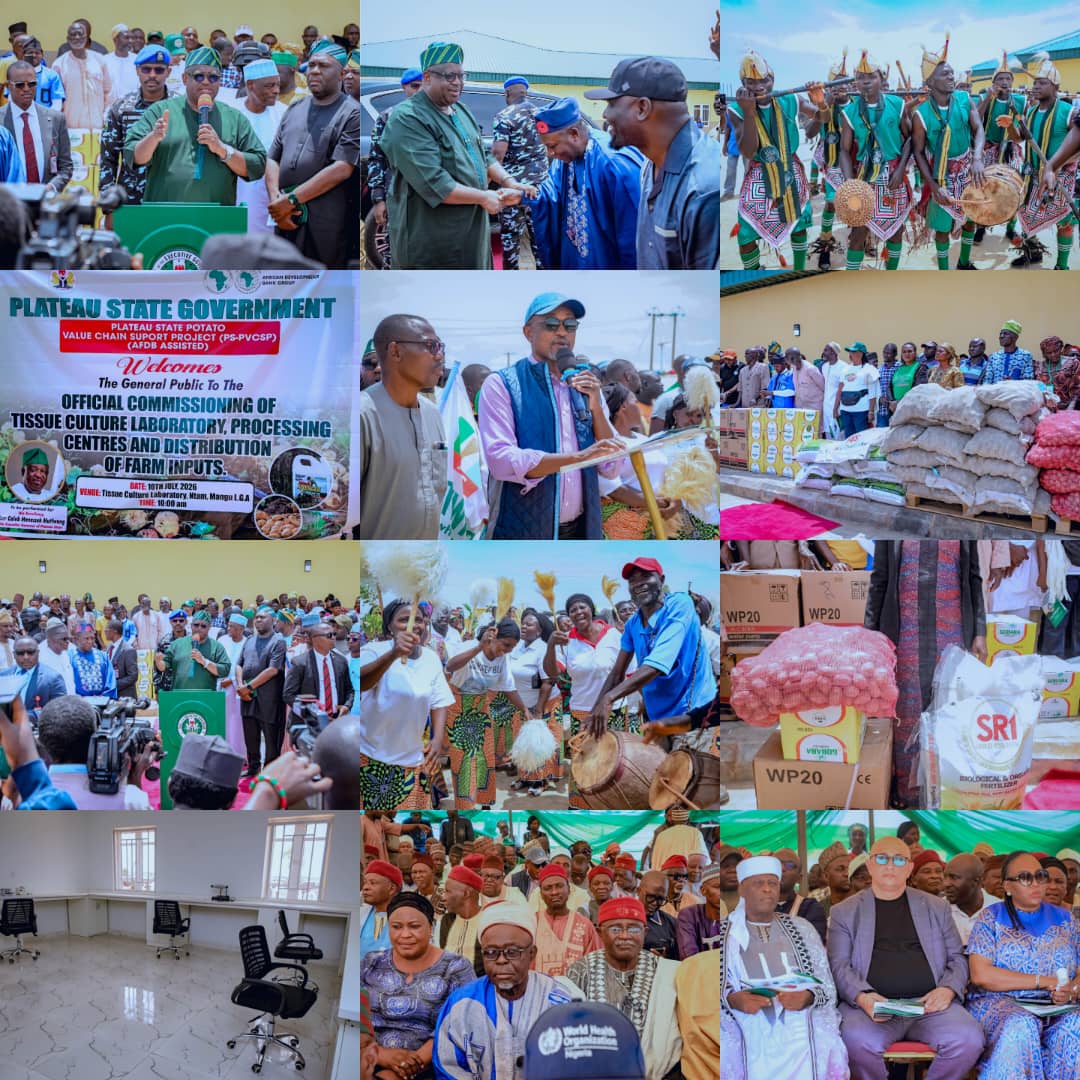
Plateau State Governor, Caleb Manasseh Mutfwang, has commissioned the Potato Value Chain Project, a modern Tissue Culture Laboratory and the distribution of agricultural equipment in Mangu Local Government Area, describing the initiative as a major step towards transforming the state into Nigeria’s leading hub for potato processing and value addition.
The project comprises a state-of-the-art tissue culture laboratory, a farmer training centre and a potato processing facility designed to improve seed production, encourage mechanised farming, increase farmers’ incomes and strengthen Plateau’s position in Africa’s potato industry.
Speaking during the inauguration, Governor Mutfwang said the project was revived by his administration after it had been on the verge of cancellation.
“Today is a story of recovery, repositioning and putting round pegs in round holes. When you get the right people to do the right job, you get the right results,” he said.
The governor noted that the potato value chain extends beyond cultivation to processing, transportation, packaging and marketing, creating employment opportunities and expanding business prospects across the agricultural sector.
Expressing concern over Nigeria’s dependence on imported potato products, Mutfwang declared that the project marked the beginning of a new era.
“We want to assure businesses across Nigeria that potatoes from Plateau State can compete with potatoes produced anywhere in the world,” he said.
He announced plans to commence local production of potato chips and potato flakes while incorporating value-added potato products into the state’s school feeding programme.
According to the governor, the project’s primary objective is to improve the welfare of citizens by creating jobs and increasing household incomes.
“Legacy is not about buildings; it is about improving the welfare of our people and putting purchasing power in their pockets,” he stated.
Mutfwang explained that the disease-free seed materials distributed to farmers were meant strictly for multiplication and not for consumption.
He urged farmers to embrace improved seed varieties, cooperative farming and mechanisation to eliminate crop diseases, increase productivity and reduce labour-intensive farming.
He also thanked the Mangu community for donating land for the project and disclosed that additional investments, including a modern processing centre, the revival of the Agricultural Services and Training Centre (ASTC) and an organised agricultural market, would accelerate industrial growth in the area.
Earlier, the Commissioner for Agriculture and Natural Resources, Samson Bugama, described the project as the beginning of the “Plateau Potato Revolution,” saying the Tissue Culture Laboratory would provide disease-free planting materials and support the development of indigenous potato varieties capable of competing globally.
Chairman of Mangu Local Government Council, Emmanuel Mwolpun, said the initiative would significantly improve productivity and reduce poverty, noting that more than 80 per cent of Plateau residents depend on agriculture for their livelihoods.
Project Director of Transparent Engineering Construction Nigeria Limited, Engr. Adegoke Olowale, commended the governor for insisting on quality and timely completion, adding that the project also created employment opportunities for youths during construction.
Also speaking, Steve Bawa of Fruits and Veggies Limited said about 3,000 farmers had already benefited from the programme through the training of 100 licensed community seed producers.
He disclosed that 10 containers of quality potato seed had been imported and planted on about 90 hectares, describing the initiative as one of the largest potato seed multiplication programmes in West Africa.
The Project Coordinator of the Plateau State Potato Value Chain Support Project, Chief Jerry Gushop, said the project had been transformed into one of the state’s most impactful agricultural programmes after years of slow implementation.
According to him, major achievements include the establishment of a modern Tissue Culture Laboratory, construction of 118.4 kilometres of rural roads and culverts, development of nine community markets and nine diffuse light storage facilities, installation of 17 spring capture systems and 22 water harvesting structures, as well as the establishment of three potato processing plants in Mangu, Bokkos and Barkin Ladi.
He added that the programme also distributed 1,000 water pumps, 1,200 bags of quality seed, 270 tonnes of improved seed varieties, agrochemicals and trained hundreds of farmers in modern seed multiplication, production, processing, packaging and agribusiness management.
“These are not just numbers; they have changed lives. They are mothers who now earn more, youths who now see farming as a business, and communities that now believe government can work for them,” Gushop said.


