


By Joseph Asegba, Yola
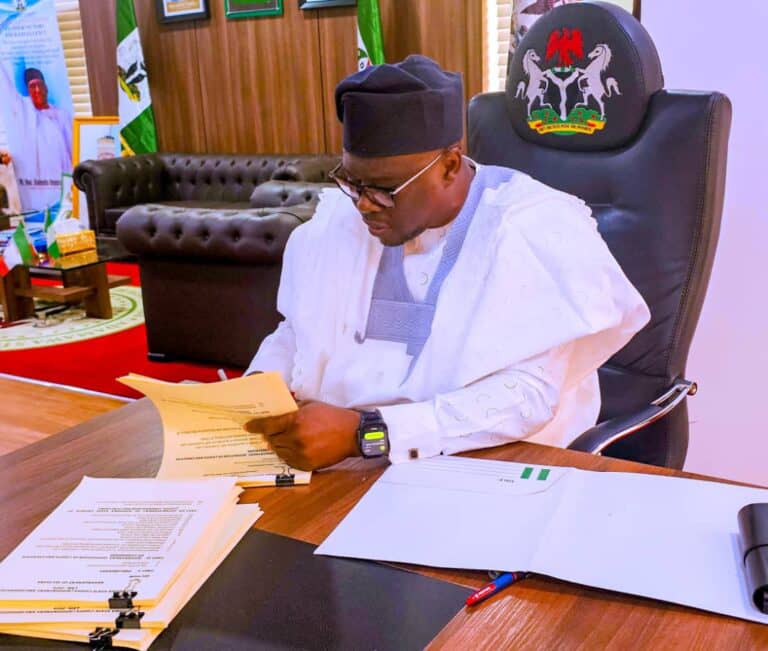
Adamawa State Governor Ahmadu Umaru Fintiri has expressed deep sadness over the recent fatal accident along the Girei-Jimeta Road and visited the homes of several bereaved families to offer his condolences.
Speaking to members of the Correspondents’ Chapel in his office in Yola, the Commissioner for Information and Strategy, Hon. Leader Teneke, said the governor was particularly saddened by the continuing accidents on the road, which have claimed innocent lives.
“One of the victims was a close relative. He has personally visited the homes of several bereaved families to offer his condolences.
“I accompanied him on one of those visits on Wednesday evening. Out of respect for the families, the administration has so far avoided turning the matter into a media spectacle,” Teneke stated.
The commissioner explained that a large section of the state capital’s population had shifted towards the higher Mega Axis, the main road corridor and the newly developing routes linking the areas.
As a result, Girei and Yola are rapidly merging into one continuous urban stretch. The sharp increase in population has also resulted in a corresponding rise in traffic volumes along the roads.
One of the most serious problems, he noted, is the near-total absence of shoulders along significant stretches of the highway. In an emergency, motorists have almost no room to pull over or manoeuvre safely.
An equally pressing concern is the rapid increase in the number of commercial tricycles, popularly known as keke napep, operating along the routes.
The problem is particularly acute on the road leading to the bridge and onward to town, especially on Wednesdays. Many of the riders, he said, are young people who have received little or no proper training before taking to the road.
According to Teneke, some owners simply purchase the tricycles and hand them over to whoever is willing to ride them in exchange for a daily remittance.
He said the same surge in traffic and safety challenges was visible on Numan Road and Irish Road, where the situation had also become particularly dangerous.
Teneke said the state government had already carried out substantial improvements in the Federal Housing Estate along the same corridor, upgrading internal road networks and drainage systems and extending the works across the other side of the dual carriageway.
However, he explained that the main highway remains a federal road and, therefore, has not been reconstructed by the state government.
Earlier, when the access road to the NYSC camp was constructed, the state government and the contractor created shoulders and improved drainage along the steep downward section approaching the bridge, an area that had previously been extremely hazardous.
Both the state government and relevant federal agencies are now examining several options to improve safety along the road.
The measures under consideration include the installation of speed bumps to reduce speeding, restrictions on the movement of heavy trucks and trailers during certain hours, such as limiting their movement between 7 a.m. and 10 p.m., and the enforcement of speed limits from the bridge through to the university area.
“Because the road is under federal jurisdiction, any such measures will require formal engagement with the Federal Ministry of Works and other relevant agencies before they can be implemented,” the commissioner noted.
He added that the administration was determined to find a workable solution that balances road safety with the legitimate needs of motorists and other road users.