


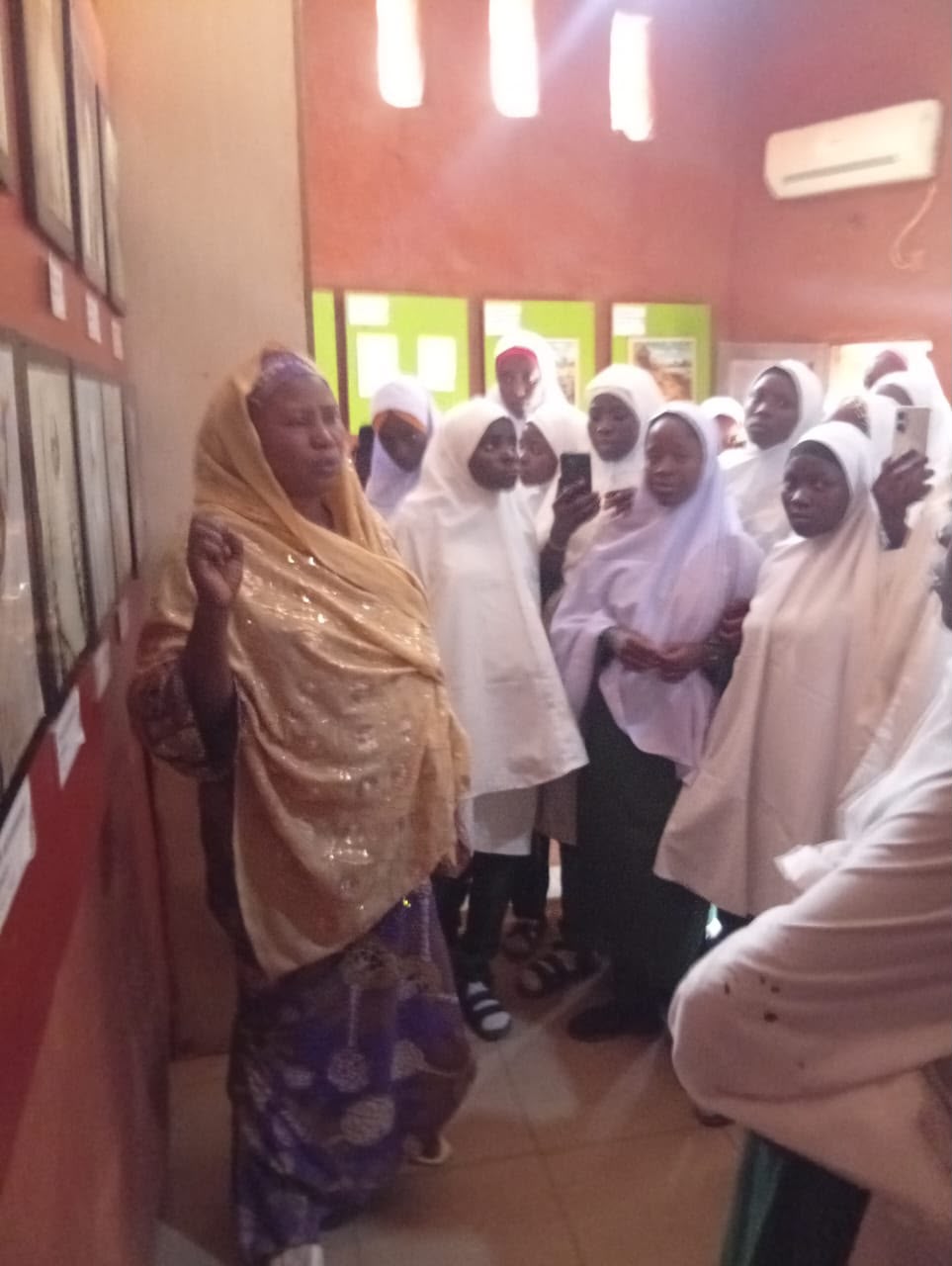
By Hassan Kasim; Shuaibu Haruna, Aishatu Suleiman; Muhammad Salim Abdulfattah; Bello Hassan; Sadiq Alhassan; National Museum Gombe
A museum is an institution that houses and cares for a collection of artefacts and other objects of cultural, scientific, artistic, or historical importance and makes them available for public viewing through exhibits that may be permanent or temporary.
Early museums began as the private collections of wealthy individuals, families or institutions of art and rare or curious natural objects and artefacts.
Museum is an active instrument for social change; this was true even when those setting up the earliest institutions had no clear idea of what social change they desired.
They desire this: that all citizens should have access to what they regarded as the wisdom and the achievements of times past so that, from such knowledge, they could build a new community for a future in our land.
Their expectation was that the museums will have a larger audience considering our African nature and the extent to which we value our culture.
Generally, all institutions have their own way in making impact and museums are not an exception. Their impacts on communities are made through their audience.
Not surprisingly, therefore this paper gives a glimpse on who are the museum audience and their learning choices.Museums are usually not run for the purpose of making a profit.
They are reputable and generally trusted source of information about cultures and history.
Definition:
International Council of Museums (ICOM) defines museum as “permanent institution in the service of society and of its development, open to the public, which acquires, conserves, researches, communicates and exhibits the tangible and intangible heritage of humanity and its environment, for the purposes of education, study, and enjoyment”.
Museums enable people to explore collections for inspiration, learning and enjoyment.Types of museums include: fine arts, applied arts, craft, archaeology, anthropology and ethnology, history, cultural history, military history, science, technology, children’s museums, maps, natural history, numismatics, botanical and zoological gardens and philately, agriculture or geology.
Another type of museum is an encyclopedic museum. Commonly referred to as a universal museum, and has collections representative of the world.
A museum normally houses a core collection of important selected objects in its field.
Objects are formally accessioned by being registered in the museum’s collection with an artefact number and details recorded about their provenance.
The persons in charge of the collection and of the exhibits are known as curators.Museum audience are the number or a particular group of people visiting the museum physically or through media to watch, read or listen to the same exhibition, ideas or explanations and all categories of museum lovers and friends.
Museums have limited impact when their audience are confined to the people who visit within the walls of the museum.
Extending beyond the museum walls into the community to demonstrate why the museum matters can benefit both the museum and the community in innumerable ways (I.N. Izuakor, 2009).
This is why museum makes provision for outreach programme to schools and other places.Learning choices of museum audienceLearning in the museum is informal and heterogeneous, so people seem to learn within or outside the museum under one of two conditions: 1) when they have to learn (compulsory learning); and 2) when they want to learn (free-choice learning in preparation).
Like many dichotomies, this one is not always clear cut but by and large, it adequately separates learning experiences into two groups.
Free-choice learning is learning just for the sake of learning, learning for fun, learning if and when the internal motivation strikes.
This is the type of learning that motivates someone to browse a museum web site or read National Geographic Magazine, watch the Discovery Channel or The History Channel or travel to foreign countries to explore ancient cities, rain forests or coral reefs, or visit a museum of interest. It is the type of learning that predominates most of daily life.
One may ask what the statistics of Nigerian museum audience is and who are they? Traditionally, this question has been answered using variables such as age, gender, race/ethnicity, education, income and occupation.
Although these variables provide some insight into the profile of a museum visitor, as suggested by Falk (1998), additional dimensions can also be considered, including variables such as leisure time interests and preferences, personal history and value variables such as early childhood experiences and attitudes towards learning and education, and a range of environmental variables such as recommendations from friends and family, cost, time, presentation and museum marketing.
Museum audience possess the following profile: they value learning; seek out the challenge of exploring and discovering new things; and place a high value on doing something worthwhile in their leisure time.
Such characteristics are shared by a variety of people, including peoples of all race/ethnicities, incomes, level of educational attainment, age and gender.
Museum visiting can be characterized as a more active, challenging leisure experience than traditionally passive leisure pursuits such as television watching.
Most of the people attending museums believe that education is an important life-long process. They perceive that there are few more interesting and important things to do in their leisure time.
They are also likely to perceive museums as places that afford opportunities to expand their own and their children’s learning horizons.It is important to note that very few people go to museums to become experts.
Rather, museum-goers are interested, curious lay people, going to generally improve their knowledge, not specifically improve their knowledge.
Museums are helpful environments in which to satisfy that desire for personal exploration of the culture, history and/or sciences.