


By Usman Usman Garba and Mahmud Gambo Sani
The International Press Centre (IPC) has urged journalists to strengthen fact-checking, investigative journalism and professional accountability to protect the credibility of Nigeria’s 2027 general elections.
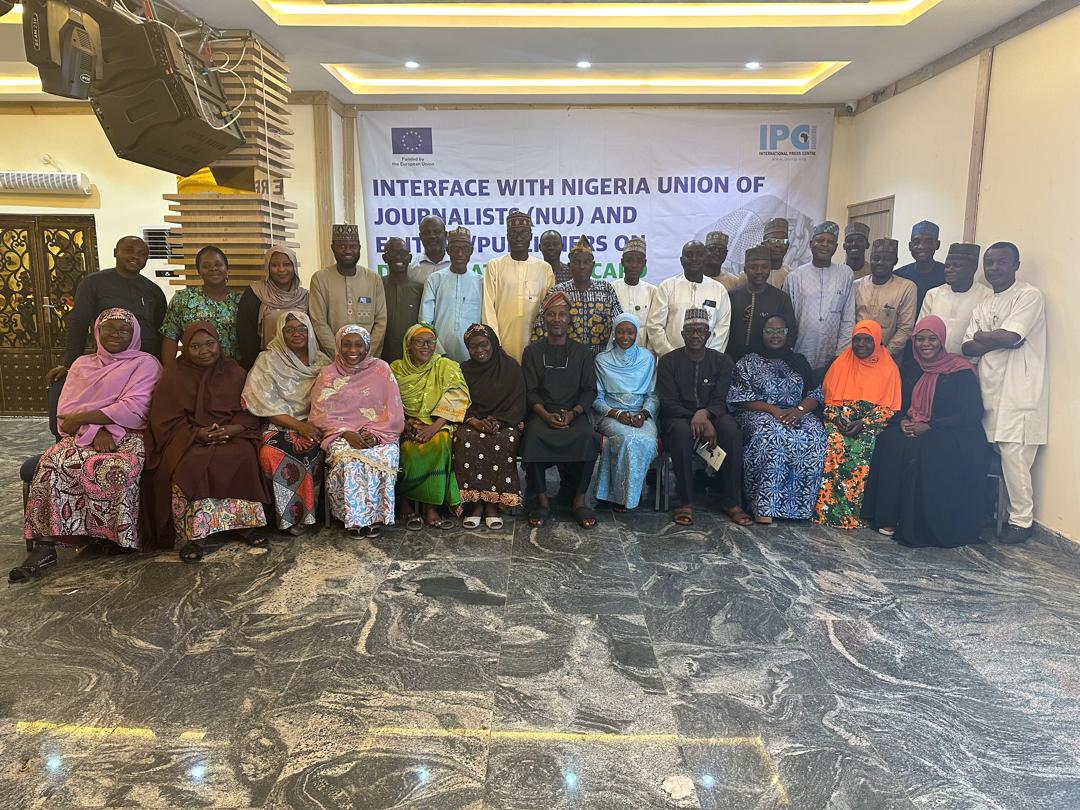
The Centre made the call during a one-day interface with the Nigeria Union of Journalists (NUJ), editors and publishers on Professional and Democratic Accountability in Journalism ahead of the 2027 General Elections, held at Hilton Palace Hotel, Kano, on November 9 and 10, 2026.
The engagement, organised under Component 4 (Support to Media) of the European Union Support to Democratic Governance in Nigeria (EU-SDGN III) Programme, focused on improving electoral reporting and promoting informed democratic participation.
The workshop emphasised that journalists must go beyond reporting political campaigns and activities to verify public claims, scrutinise candidates’ promises, monitor governance and provide citizens with credible information.
It identified misinformation, disinformation, manipulated images, artificial intelligence-generated content and deepfake videos as growing threats to the electoral process, warning that false information could encourage voter suppression, trigger political violence and undermine public confidence in election results.
Journalists were therefore advised to verify information through credible sources, examine supporting evidence, consult experts and give individuals or institutions concerned an opportunity to respond before publishing investigative reports.
In her presentation titled “The 2027 General Election in the Context of Democratic and Accountability Reporting: Scanning the Electoral Environment and Reporting Citizens’ Priority Concerns,” Dr. Ruqayyah Yusuf Aliyu of the Department of Information and Media Studies, Bayero University, Kano, said the media had a critical responsibility in safeguarding electoral integrity.
She called for comprehensive reporting covering the entire electoral cycle, including the scrutiny of campaign promises, monitoring of electoral institutions, investigation of political financing and exposure of vote-buying and misuse of public resources.
Aliyu also identified security, political violence, electoral credibility, accessibility for persons with disabilities and internally displaced persons, technological failures and economic hardship as major concerns that should shape election coverage.
She urged journalists to focus on issues affecting citizens rather than merely following political contests, stressing the need to examine how government policies and candidates’ proposals address public concerns.
Earlier, IPC’s IT and Social Media Officer, Abiodun Adeleke, who delivered the welcome remarks on behalf of the Executive Director, Dr. Lanre Arogundade, described the media as a strategic institution in strengthening democracy.
Adeleke urged journalists to prioritise accuracy, fairness, verification and conflict-sensitive reporting, while ensuring that women, young people and other underrepresented groups receive adequate attention in electoral discourse.
He also stressed the importance of journalists’ safety and professional independence, warning against intimidation, harassment and unlawful interference in the discharge of their duties.
He appreciated the NUJ Kano State Council for its support and the European Union for funding the engagement under the EU-SDGN III Programme.
The workshop called on media practitioners to uphold truth, balance and accuracy, noting that credible elections depend not only on the ballot box but also on the quality of information available to citizens.