


…As Technical Workshop for Aquaculture Farmers Enters Demo Day Two
By Usman Usman Garba
The FISH4ACP Catfish Cluster Upgrading Programme has continued its technical workshop for aquaculture farmers, with Demo Day Two of the demonstration session drawing dozens of participants eager to showcase the lessons they have acquired in modern fish farming.
FISH4ACP, an initiative of the Organisation of African, Caribbean and Pacific States (OACPS) is designed to strengthen fisheries and aquaculture value chains across participating countries.
The programme is implemented by the Food and Agriculture Organization (FAO) with funding support from the European Union and the German Federal Ministry for Economic Cooperation and Development (BMZ).
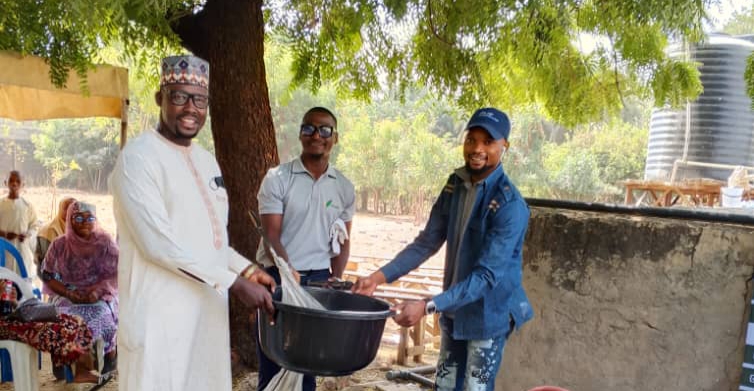
The Day Two demonstration, held on Saturday in Kumbotso Local Government Area of Kano State, provided hands-on training for farmers.
Chairman of the farmers’ association, Malam Nura Uba Ramadan, described the programme as transformative, noting that sessions are held twice a week and have significantly improved farmers’ understanding of best practices.
According to him, the training has reshaped farmers’ mindset and corrected long-standing mistakes in fish rearing.
“Many farmers used to complain about feeding costs. But the training made them realise they were feeding the water instead of feeding the fish. This knowledge alone has changed their approach completely,” he said.
On behalf of the farmers, Malam Ibrahim further explained how the group has transitioned from manual to digital farm management through the use of the Aquadata Management System (ADMS).
He observed that before the intervention, most farmers had no form of database to track production, but now all participants can record and monitor every activity on their farms.
He demonstrated how ADMS helps farmers document feeding schedules, stocking, water quality checks, and harvest data.
Ibrahim also emphasised the importance of sorting fish by size, maintaining proper timing, and keeping accurate records practices that significantly improve stock survival.
“When sorting is ignored, bigger fish end up eating smaller ones. But when properly carried out, farmers can retain 80 to 90 percent of their stock. Failure to sort leads to heavy losses,” he noted.
Programme Manager for Vetsark in the Kumbotso Cluster, Mayowa Ajayi, explained that the FISH4ACP training is being conducted simultaneously in five states: Kano, Gombe, Delta (Asaba), Kwara, and Ogun.
These states, he said, were selected because of their organisational structure and the existence of active clusters and associations.
He clarified that the programme does not cover all 44 local government areas in Kano State at this stage. Currently, only the Kumbotso cluster is undergoing the training.
The programme, according to him, is now in its sixth month, is expected to run for another six months.
Ajayi also revealed that although about 100 farmers were initially profiled under the PFFAG association, the training has now recorded more than 200 participating farmers.
The programme continues to align with global efforts to improve sustainable aquaculture practices.
Notably, World Fisheries Day which is marked annually on 21 November highlights the importance of sustainable fish stocks, the rights of small-scale fishing communities, improved working conditions, and the fight against illegal, unreported and unregulated fishing.