


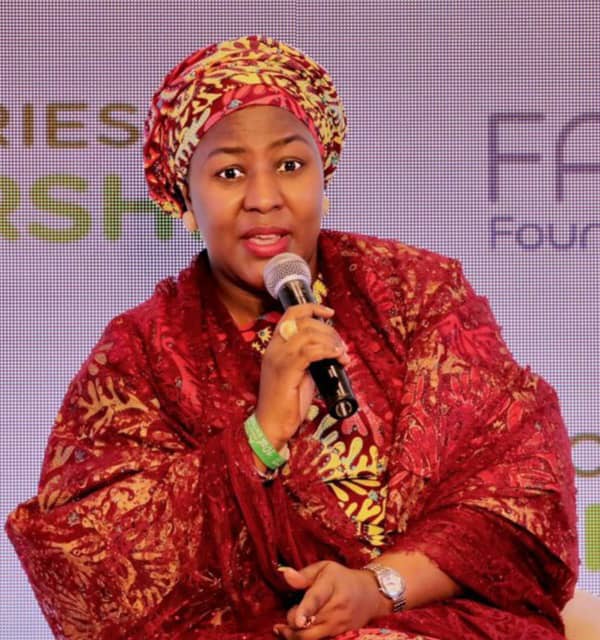
By Usman Usman Garba
Some leaders rise through noise. Others rise through power plays. But in Katsina, one woman is rising through something far more rare, quiet influence backed by real work.
Her name is Hajiya Aisha Aminu Malumfashi: Commissioner for Women Affairs, daughter of the royal household of the Galadiman Katsina, and the widely respected Inna Wuro of Malumfashi.
In Malumfashi, where tradition still shapes daily life and the emirate remains a powerful moral anchor, certain households stand out for their history and quiet influence. The home of the Galadiman Katsina, the District Head of Malumfashi is one of them.
It is a home where leadership is inherited not as a privilege but as a duty. It is a place where community matters are settled, where guidance is sought, and where leadership is lived, not performed.
From this environment emerged a woman now redefining what female public service looks like in Katsina State: Hajiya Aisha Aminu Malumfashi, Commissioner for Women Affairs and Inna Wuro to Galadiman Katsina.
She is many things at once: Commissioner for Women Affairs, Inna Wuro to Galadiman Katsina, the daughter of royalty, a modern administrator, a mother, an advocate, and increasingly, a political personality whose future seems brighter than the office she currently occupies.
From childhood, Aisha grew up in a home where people constantly walked in and out seeking advice, mediation, or guidance from her father, the District Head. To a young mind, this was leadership in its rawest form, not the political speeches or ceremonial appearances, but the daily labour of solving real community problems.
She often watched decisions being made with wisdom, fairness, and patience. She saw conflict resolved through dialogue. She observed elders and youth treated with equal dignity.
These experiences shaped her more deeply than any classroom could. They formed a foundation of respect, composure, empathy, and service qualities she would later carry into public office.
Her traditional title, Inna Wuro, is not symbolic. Within the emirate system, “Inna” represents maternal guidance, one who stands as a pillar of support in traditional households. For Hajiya Aisha, the title reflects who she has always been: a unifier, a comforter, a problem-solver, and a woman who carries the cultural expectations of leadership with grace.
Her journey into education was guided by her father’s insistence that “tradition without knowledge is incomplete.” Thus, Aisha excelled in her studies, gaining exposure to administration, community development, and social policy — fields that would later form the core of her professional life.
Those who knew her during her university years, remember a woman who was quiet but firm, friendly but disciplined, ambitious but deeply rooted in humility. She was never the loudest voice in the room, but always the one whose ideas carried weight.
In her journey to public service, for many, her appointment as Katsina State Commissioner for Women Affairs seemed sudden. For those who knew her well, it was long overdue.
Before politics, she had built a reputation through: grassroots engagement, women’s skills training initiatives, community mediation, youth mentoring, strong relationships with civil society and traditional institutions.
Her work in government, her royal background, and her growing influence among young women have positioned her as one of the most interesting personalities to watch in Katsina today
Her work aligned naturally with the ministry she now leads. And once she assumed office, it became clear that she came not to warm the chair, but to change the system.
In a government space where “programmes” often mean paperwork and pictures, she insisted on real impact: Protecting vulnerable women, expanding economic opportunities, strengthening shelters, supporting widows, championing girl-child education, engaging NGOs and development partners, making the ministry accessible to ordinary people and her approach is firm, simple, and results-oriented.
Indeed, balancing a royal identity with a public position is never easy. Yet Aisha makes it appear natural. As the Inna Wuro of Galadiman Katsina, she represents tradition, cultural integrity, and the timeless values of the emirate.
As a commissioner, she represents modern governance, problem-solving, and pragmatic leadership. Few women in northern Nigeria carry both worlds with such subtle authority. She is respectful of tradition but never restricted by it. Gentle in public but firm in boardrooms. Warm in community settings but decisive when dealing with issues like Gender Based Violence (GBV), poverty, and women’s rights.
This dual identity has made her an influential bridge between government and grassroots, between old structures and new realities, between policy and lived experience.
Friends and family describe her as: calm, organised, deeply spiritual, compassionate, intentional about her relationships and surprisingly modest for a woman of her standing.
Her home life is grounded in routine, spirituality, and family. She values privacy but carries her responsibilities into every space she enters.
In conversation, she listens more than she speaks. But when she speaks, people notice.
It is no secret in Katsina political circles that Hajiya Aisha is becoming one of the most intriguing personalities to watch. Her work at the Ministry of Women Affairs, coupled with her royal lineage, grassroots acceptance, and growing influence among young women, has opened doors to future political possibilities.
Whether she chooses elective office, expanded executive roles, or a continued journey in public service, one thing is clear: Hajiya Aisha Aminu Mununfashi is no longer just the Commissioner or the Inna Wuro, she is becoming a symbol of a new generation of female leadership in Katsina State.
Her journey is still unfolding, and her influence continues to grow. For now, she remains the Commissioner, the Inna Wuro,and the calm force reshaping how leadership is quietly but powerfully exercised in Katsina State.
Aisha Aminu Mununfashi, our Inna Wuro. Your journey is still unfolding, but one thing is clear, a new northern female leader is taking shape, quietly, steadily, and with growing influence from Katsina to the national level.
Usman Usman writes from Kano and can be reached via usmangarba100@gmail.com; 08069771400