


By Ado Salisu
The curtains may have fallen on the 24th edition of the CAA Senior Athletics Championships in Ghana, but the echoes from Accra continue to reverberate across the continent.
Beyond the medals, records and national pride lies a pressing conversation about the future of African athletics, one that demands urgent action from governments, corporate institutions and the Confederation of African Athletics (CAA).
For all its moments of brilliance, the championship also exposed a painful contradiction: Africa continues to produce some of the greatest athletes in the world, yet struggles to assemble those same stars at its biggest continental event.
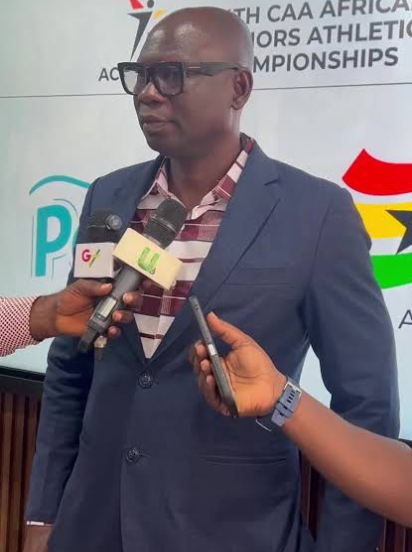
The President of the Ghana Athletics Association, Bawah Fuseini, did not shy away from confronting that reality.
Reflecting candidly on the tournament, he revealed how Ghana fought to secure sponsorship for the continental event while grappling with the absence of many elite African athletes.
“We used some of our domestic athletes to secure sponsorship from Ghana, and we also relied on some African athletes to attract continental sponsorship.
“Unfortunately, we were unable to attract enough top African athletes to participate in this championship.
“That is why we were able to secure local sponsors but not international support. If we had been able to incentivize those top African athletes to come, we could have used their presence and participation to attract international sponsorship for this competition,” he said.
His words strike at the heart of the challenge facing athletics on the continent.
Sponsorship follows visibility, and visibility follows star power. Without Africa’s elite athletes consistently competing at the African Championships, the event risks losing commercial relevance in the highly competitive global sports market.
Fuseini pointed to football as the model athletics must learn from.
“We can compare the Confederation of African Football (CAF) with the Confederation of African Athletics (CAA).
“Whenever there is an Africa Cup of Nations tournament, almost all countries come with their best footballers. That is why CAF always secures sponsorship for the Nations Cup. If we are not able to do the same, we will not get sponsorship,” he said.
The comparison is difficult to ignore. The Africa Cup of Nations has become one of the continent’s strongest sporting brands because African nations treat it with prestige and priority.
The continent’s biggest football stars proudly answer the call. Broadcasters invest heavily, sponsors compete for visibility and governments rally behind the tournament.
Athletics, despite Africa’s dominance on the global stage, has yet to create that same continental identity around its flagship championship.
“Africa has the best athletes in the world, yet our best athletes do not compete in our biggest event in Africa. That is something the CAA must address,” Fuseini added.
That statement should serve as a wake-up call for the CAA.
The future of the African Championships cannot continue to depend solely on the goodwill and sacrifices of host nations.
What is urgently needed is a strong and enforceable policy framework from the CAA — one that protects the integrity and prestige of its elite competition.
Such a framework must prioritize elite athlete participation where possible, better calendar alignment with global competitions, appearance incentives for top athletes, stronger commercial packaging and long-term sponsorship structures.
Without these reforms, the championships may continue to struggle for relevance despite the continent’s unmatched athletic talent pool.
Fuseini admitted that there are deeper structural challenges beyond athlete participation.
“To ensure that top African athletes participate in the African Championships, we must also address challenges relating to organization, feeding and technical matters. If we do not attract the best athletes to secure the necessary funding to solve these problems, the challenges will continue,” he explained.
It becomes a vicious cycle: weak funding leads to organizational limitations, while organizational limitations make it harder to attract elite athletes and premium sponsors.
And at the center of it all remains Africa’s oldest sporting obstacle — funding.
“You know the African problem is funding. If a state tells you that if you organize the competition within a certain period they will support you financially, but at another time they will not, then you have no choice.
In Ghana, we had a peculiar situation that forced us to move the competition from July to May,” he said.
The decision to move the championships to May became controversial in some quarters, especially because many African student-athletes based in the United States were unavailable. Yet Ghana insisted the move was necessary to secure government backing and avoid clashes with major international sporting events.
Fuseini explained the difficult balancing act.
“Football in Ghana is a completely different ball game. When there is a World Cup, everything else stops.
“If you organize your program during the World Cup period, you can be sure it will not get attention. To ensure Africa did not miss this championship, we moved it to May, knowing very well that some students based in the United States would not be able to participate. That also affected us,” he stated.
Even Ghana itself suffered competitively from the absence of key athletes abroad.
“We also have some of our top athletes in the US college system and they were unable to come. But should the whole of Africa wait until August because Ghana would not have its best athletes?
“The program is for Africa, not just for Ghana or any other country. That is why we scheduled it in May so we could secure government and Sports Ministry support,” he added.
The explanation underscores the complexity of hosting a continental event in Africa, where organizers must navigate government financing cycles, international sporting calendars and logistical realities with limited resources.
Fuseini further explained how the World Cup, the Commonwealth Games, the World Junior Championships and the Youth Olympic Games all created scheduling complications.
“We considered all these factors before deciding whether to hold the event before the World Cup or postpone it until next year. Postponing it was not an option we could consider. That is why we brought it to May. Despite the challenges, we successfully hosted the championship,” he said.
Yet despite the obstacles, Ghana delivered the championships. Perhaps that is the strongest takeaway from Accra: Africa continues to stage world-class competitions through resilience, sacrifice and determination, often without the financial strength available elsewhere.
But resilience alone cannot sustain elite sport forever.
For African athletics to truly evolve, Africa itself must stand firmly behind its championship. Governments must see sports as economic and diplomatic investments rather than ceremonial activities.
Corporate Africa must recognize the commercial potential of athletics. Most importantly, the CAA must establish policies that elevate the African Championships into a must-attend event for every elite African athlete.
Fuseini’s closing remarks carried both frustration and hope.
“We will continue to advocate for more funding because all these issues are directly linked to funding,” he said.
“If we had enough funds ourselves, we would have bought our tickets directly instead of going through an agency. We were hoping that if we secured adequate funding, we would not need to rely on third parties.”
Lamenting further, Fuseini said:
“It was due to financial constraints that we had to go through all those processes. But going forward, now that we have a sports fund in Ghana, I am hopeful that things will improve in terms of sports funding.”
The message from Accra is loud and clear: Africa does not lack talent, and Africa does not lack passion. What the continent’s athletics ecosystem needs now is structure, commitment and a collective resolve to protect and elevate its own championship.