


By Christiana Gokyo, Jos
The Plateau State Youth Council (PYC) has expressed concern over the lack of meaningful youth inclusion in Nigerian governance, calling for greater collaboration in policy development and validation.
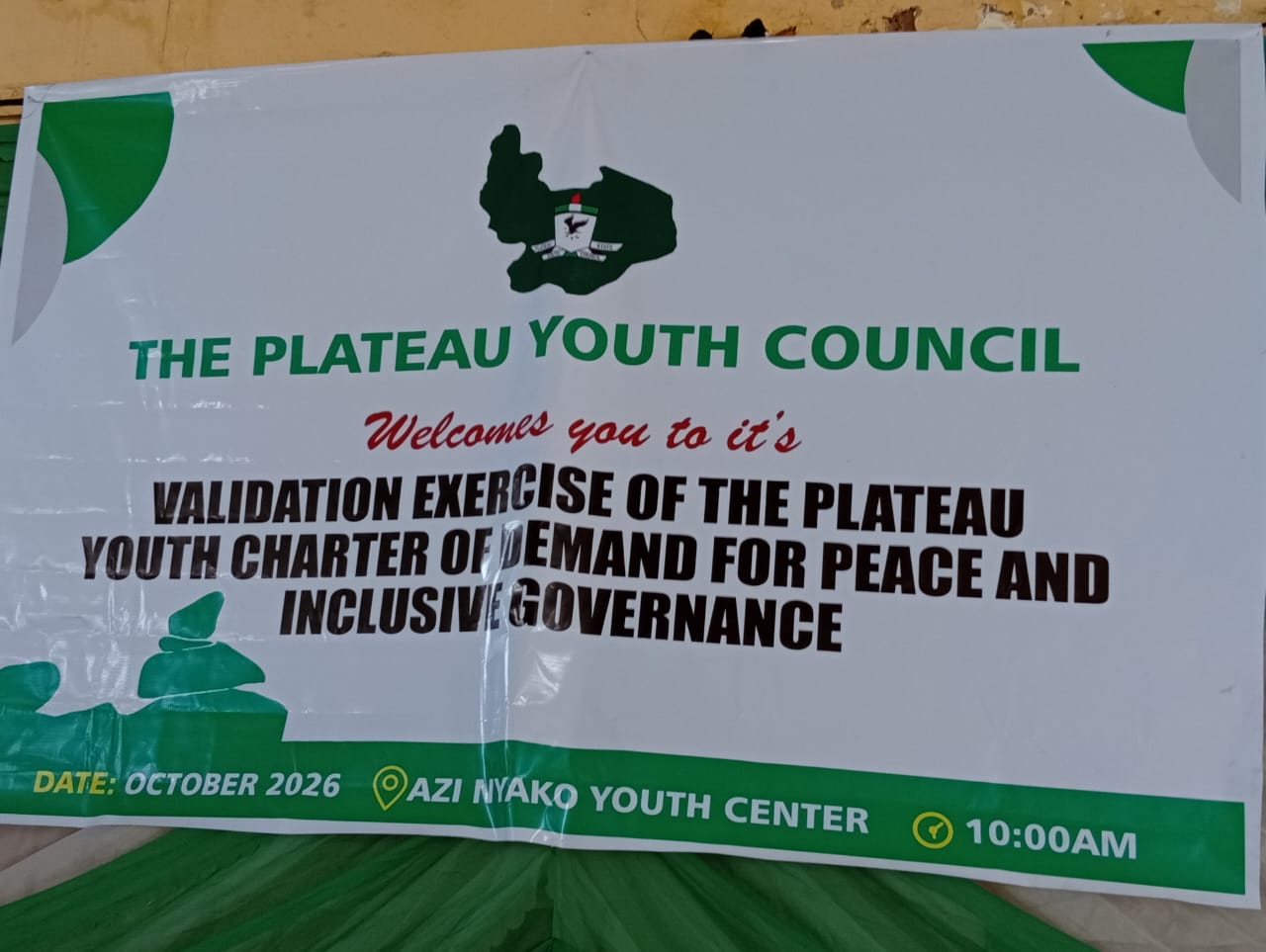
The Chairman of the Plateau State Youth Council, Panan Gongden Dapar, disclosed this on Tuesday during a validation workshop held at the Azi Nyako Youth Centre in Jos.
The workshop was organised by the Plateau Youth Council in collaboration with the Youth Initiative Against Violence and Human Rights Abuse (YIAVHA) to review and validate the Plateau Youth Charter of Demand for Peace and Inclusive Governance.
The charter is designed to promote meaningful youth participation in peacebuilding, inclusive governance, democratic processes and economic empowerment in Plateau State.
Speaking at the event, Dapar highlighted what he described as a significant gap in Nigeria’s political landscape, where young people are often excluded from meaningful decision-making processes.
He noted that young people are frequently mobilised temporarily by those in power without being given sustained influence or representation within governance structures.
The chairman emphasised the importance of the initiative in promoting youth involvement in government policies and programmes.
He stressed that the validation process must directly involve young people, while the government should provide clear policy agendas that enable them to contribute meaningfully.
He added that collaborative efforts would help ensure that policies reflect the interests of young people while benefiting society as a whole.
The workshop also examined the Plateau Youth Council’s plans to develop key performance indicators (KPIs) to assess political leaders’ commitment to youth-related issues.
According to the council, the primary objective of the document is to move the organisation beyond mobilisation and establish it as a platform for constructive political engagement.
The document is intended to provide measurable indicators for assessing political leaders and parties based on their commitments to young people ahead of the 2031 elections.
Its strategic objectives include shaping political discussions ahead of the 2027 elections, ensuring the inclusion of young people, women and persons with special needs in policymaking, and establishing a framework for holding politicians accountable for their commitments to youth-led agendas.
Dapar further stressed that the council must present concrete demands to politicians to ensure that engagements lead to meaningful outcomes rather than serving as distractions.
He explained that publishing the charter early would enable the council to influence the development of political party manifestos before they are finalised.
The document also emphasises that the inclusion of women, young people and persons with special needs should be treated as a necessity rather than an afterthought.
Dapar highlighted the importance of listening to the distinct experiences and challenges of young women.
He also encouraged participants to express themselves in any language they felt comfortable using to ensure their views were accurately captured.
In his remarks, the Director of YIAVHA, Jacob Pwakim, said the new strategic document developed by the Plateau Youth Council was designed to shape political discourse in the state.
According to him, the document establishes specific performance indicators for politicians seeking to demonstrate meaningful engagement with young people.
He explained that the initiative would introduce measurable benchmarks for political candidates and provide for post-election assessments of politicians and their respective parties based on the established indicators.
Pwakim added that the framework would also enable political leaders to align their agendas with the actual needs of communities across Plateau State.
He further explained that the initiative was part of a broader effort to strengthen youth organisations and support their participation in peacebuilding and governance.
According to him, the activity is supported under the Building Bridges for Peace: From Insight to Action project, with primary funding from Strengthening Peace and Resilience in Nigeria (SPRING), alongside additional support from the UK Foreign, Commonwealth and Development Office.