





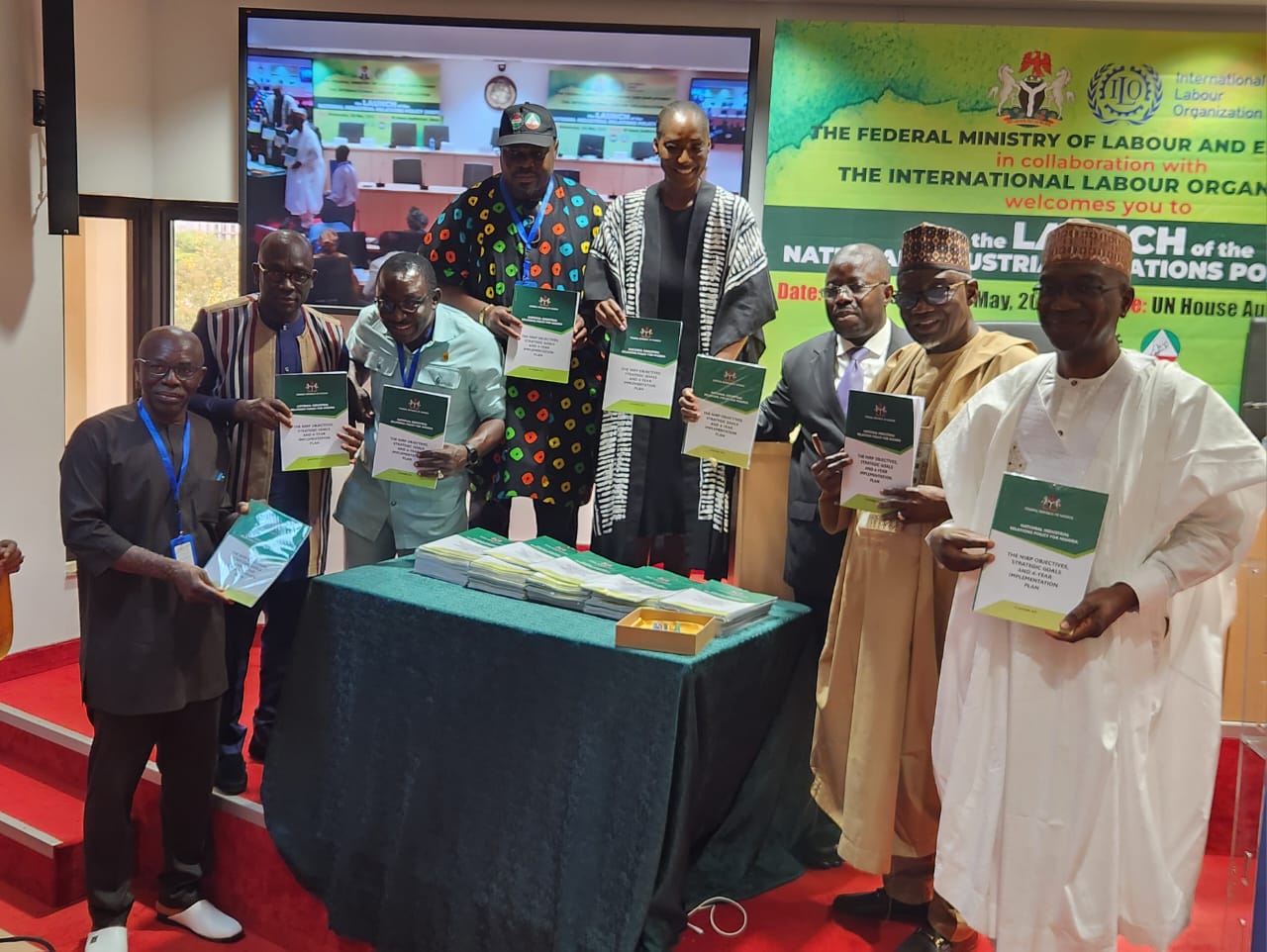
From Atiku Sarki, Abuja
The Federal Government, in collaboration with the International Labour Organisation (ILO) has on Wednesday in Abuja officially launched the National Industrial Relations Policy (NIRP), aimed at promoting industrial harmony, decent jobs, and economic growth in the country.
The Minister of Labour and Employment, Dr. Muhammad Maigari Dingyadi, while launching the policy at the United Nations House in Abuja, noted that for decades Nigeria’s industrial relations space has been guided by statutes, conventions, and practice without a unifying policy framework.
He said disputes that should be resolved at the workplace often escalate, while collective bargaining is sometimes adversarial rather than collaborative.
According to him, the National Industrial Relations Policy rests on three pillars, including social dialogue, where government, employers, and workers are treated as equal partners.
He added that it seeks to strengthen the National Labour Advisory Council and Sectoral Joint Councils as platforms for continuous engagement.
He said the policy also reaffirms freedom of association, effective collective bargaining, elimination of forced and child labour, and non-discrimination, in line with ILO core conventions ratified by Nigeria. It also aims to create more jobs, better wages, and competitive enterprises.
The Minister further explained that the policy links dispute prevention to enterprise development, skills acquisition, and occupational safety.
“Distinguished ladies and gentlemen, industrial harmony is not the absence of conflict. It is the presence of institutions and trust to manage conflict. With this policy, we are choosing dialogue over disruption, partnership over protest, and progress over polarization,” he said.
Dingyadi said under President Bola Ahmed Tinubu’s Renewed Hope Agenda, job creation and poverty reduction remain central priorities, noting that government cannot create jobs in an atmosphere of distrust, nor reduce poverty where wages are lost to avoidable strikes.
He stressed that when factories run, farms operate, and schools remain open without disruption, workers and the economy both benefit.
He maintained that the policy was not imposed by government but was the product of six years of tripartite consultations.
He thanked the ILO for its technical and financial support, and commended the Nigeria Labour Congress (NLC), Trade Union Congress (TUC), and Nigeria Employers’ Consultative Association (NECA) for their constructive engagement, urging stakeholders to use the policy to deepen dialogue and ensure strikes remain a last resort.
The Minister also appreciated the inter-ministerial committee and ministry officials who developed and refined the document, assuring that implementation would be a priority, noting that “a policy is only as good as its implementation.”
On institutional reforms, he said the ministry would upgrade key labour institutions, including the Industrial Arbitration Panel and the National Labour Advisory Council, to ensure faster dispute resolution.
He added that capacity-building programmes would be rolled out nationwide for trade union leaders, human resource managers, and labour officers on interest-based bargaining and mediation.
He also announced plans to establish a National Industrial Relations Observatory to detect and address workplace grievances before they escalate into strikes.
He noted that over 80 per cent of Nigeria’s workforce is in the informal sector, adding that the policy extends dispute resolution and social protection frameworks to artisans, market associations, and platform workers through cooperatives.
In her remarks, the Director of the ILO Office for Nigeria, Ghana, Sierra Leone, Liberia, and Liaison Office for ECOWAS, Vanessa Phala, commended all stakeholders involved in the policy process, including employers’ organisations, for their commitment and constructive engagement.
She said their contributions ensured that the policy is grounded in Nigeria’s economic and entrepreneurial realities, adding that sustainable competitiveness can only be achieved through dialogue, clear rules, and mutual trust.
Phala described the policy as co-created, born out of dialogue, deliberation, and robust debate, guided by consensus and collective responsibility.
“This is not a policy imported from elsewhere, nor a reform imposed from outside. It is a co-created policy, born out of dialogue, deliberation, and robust debate, but always guided by a shared commitment to consensus and collective responsibility,” she said.
She added that the policy offers a forward-looking framework where labour actors work coherently within strong institutions and mechanisms for preventing and resolving disputes.
According to her, it addresses both traditional labour issues such as social dialogue, collective bargaining, and dispute resolution, as well as emerging challenges including technological transformation, ecological transitions, demographic changes, and the future of work.
Phala reaffirmed the ILO’s continued support to Nigeria in implementing, monitoring, and evaluating the policy, pledging technical expertise, normative tools, and partnerships to ensure effective outcomes for workers, employers, and society.
Earlier, the Permanent Secretary, Federal Ministry of Labour and Employment, Dr. Kamil Shoretire, said the policy provides a framework for preventing disputes, strengthening collective bargaining, protecting workplace rights, and promoting enterprise sustainability.
He said, “The real work starts now — to sensitize, domesticate, and apply it at workplaces across the 36 states and the FCT.”
In their goodwill messages, the Director General of NECA, Mr. Adewale Oyerinde, the President of the Nigeria Labour Congress, Comrade Joe Ajaero (represented by Comrade Echezema Ashuze), and the President of the Trade Union Congress, Comrade (Engr.) Festus Osifo (represented by the Secretary General, Comrade Dr. Nuhu Toro), expressed optimism that the policy would strengthen respect for workers’ rights and improve conditions of work, wages, livelihoods, and dignity of labour.


