


By Muhammad Hamisu Abdullahi
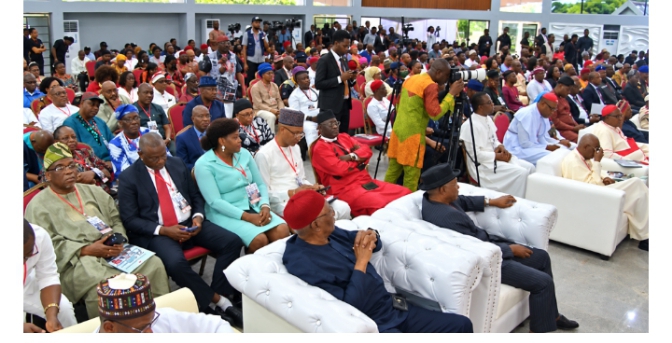
The 22 All Nigerian Editors Conference (ANEC), which was held in Enugu, the capital of Enugu State, has come and gone.
Interestingly, the state governor, Mr. Peter Ndubisi Mbah, hosted the event via the state government.
What made the event so unique was its composition where more than 300 members of the Guild assembled in the city for the conference.
The conference started successfully on day one with speeches from selected speakers who were carefully selected to do justice to the topics they were assigned to speak on.
It culminated into day two with the speakers drawn from various fields of human endeavours and who digested the chosen topics objectively .
Day Three, which was Saturday, brought the participants of the conference to a tour of projects executed under the ‘Tomorrow is Here’ administration in the last three years.
The tour was coordinated and led by Secretary to the State Government, Prof. Chidiebere Onyia.
The participants were taken to Enugu East Senatorial District, where they inspected dual road project linking the state with the neighbouring Ebonyi State, which passes through New Enugu City.
Still in Enugu State, the conference attendees inspected another 40km Owo-Ubahu-Amankanu-Umualor-Ikem Road with a stopover at Livestock Hub, Ubahu.
There was another stopover at Model Secondary School, Owo.
The livestock hub is a cattle ranch, which is on the basis of joint effort between the state government and private developers on Build Operate and Transfer basis, is expected to bring to the state a sizeable revenue generation, and the cattle are expected to arrive from Northern part of the country through the access dualised road provided by the state government for ease of doing business at the ranch.
The smart model secondary school project at Owo entails erection of some befitting storey buildings replica of what obtains in universities to equip the students with good example of the experience in universities.
It was a continuity idea from the smart nursery and primary schools planned to be built in all the wards in the state, while the smart secondary schools are planned to be provided across the three Senatorial Zones of the state to take care for the need of gifted students in the state.
What has been deduced was that the students emanating from smarts primary schools in the state are expected to come from their respective Senatorial Zones with no expenses from parents as the state government would shoulder all their responsibilities right from uniforms, desks, chairs and other instructional materials to include their feeding.
That is to say that a student from East Senatorial Zone is not expected to be seen in another zone for the smart secondary school programme.
The state government was responsible as it took care of the compensation commitment of land it acquired from their original owners for effective justice dispensation system in the state.
They were also at Ngwo Pine Forest Zipline and Tourism Development project site, which when completed will be a beautiful tourism centre to behold in the state.
From tourism development center, the participants were taken to Enugu International Hospital, which is none to others.
It was a facility that suits international standards equipped with modern technology, where everyone would be proud of accessing its services as it is happening in the country.
From there, they were taken to the Command and Control Centre in Enugu as part of the projects tour.
It was a gigantic project that takes care of the security of the entire state worthy of copying by other states of the federation.
After that, a round table interview with the governor was held after which there presence of the editors at a Gala Night they ate, drank, entertained, speeches made and fellows and new inductees were sworn-in before the governor and his entourage.
The Gala Night was conducted at the Banquet Hall, Lion Building of the Dome International Conference Center, Michael Okpara Square Road, Independence Layout in the city of Enugu.
Tagged: ‘The Ballot, the Media and the Task of Keeping Democracy Alive,’ the event proper on day one was declared open by Vice President Kashim Shettima, who urged the editors in the country to strengthen professional journalism and verification systems as artificial intelligence introduces new complications for the credibility of information ahead of future elections.
It has its sub-theme as ‘When Lies Look Real: Detecting and Debunking AI Disinformation Before, During and After Election.’
The Vice President asked the editors in the country to do everything possible to promote democracy for it to continue to thrive in the nation.
Alhaji Shettima was speaking via zoom from America, where he was attending United Nations General Assembly meeting, asked the editors to prioritise the country above anything else.
He said they have a vital role to play in the survival of democracy in the country, reminding the people of the nation to know that they have no any other country than Nigeria, adding that they should work towards its unity and progress.
Speaking, His Royal Majesty, Igwe Nnaemeka Alfred Achebe, Obi of Onitsha, said he was delighted to be part of the event.
The monarch thanked all members of the Guild for the work they have been doing for the good of country.
He said: “I have watched Nigeria’s journey from the optimism of independence, through the turbulence of military rule, into the fragile and still-unfinished project of democratic self-governance.
“It is in that spirit of witness, and of shared responsibility, that I speak to you today.
“You have chosen a theme of unusual gravity: ‘The Ballot, the Media and the Task of Keeping Democracy Alive.’
“I want to dwell, for a moment, on that phrase – ‘keeping democracy alive.’
“It presupposes something many of us take for granted.
“Some of us may think that democracy, once established, sustains itself.
“We that it does not.
“Democracy is not a monument we erect and then walk away from.
“It is more like a fire lit to keep the house warm.
“It must be tended, fed, protected from wind and rain, or it dies quietly in the night while everyone believes it still burns.
“In our Igbo tradition, the Obi does not rule by decree.
“He rules in council, in dialogue, in the constant testing of truth against the wisdom of elders and the voice of the people.
“Igbo democratic instinct is ancient.
“Even kingship here has always been checked by community, by consultation, by honest speech.
“The ballot box, in this sense, is not an import grafted onto our soil.
“It is a modern vessel for an old African value, which states that legitimate power flows from the consent, the voice, and the informed judgment of the people.
“But consent is only be meaningful if it is informed.
“And this is where you, the editors of this nation, become not merely chroniclers of democracy but its guardians also.”
On his part, the immediate past Cardinal Archbishop Emeritus of Abuja Catholic Diocese, Chief John Cardinal Onaiyekan, described democracy as not entirely new to the people of the nation.
He urged those in power to exercise it with carefulness and due consultation with those who matter.
He said as the nation became independent from colonial rule, it should be in a position to rule itself in a democratic way.
“We inherited a very weak democracy, despite the Constitution that we drew up for ourselves under the guidance of the colonial masters who gave us independence, as the expression goes,” he said.
On election, he said: “Elections are meant to choose leaders at all levels and to assess their performance.
“In Nigeria, our elections are guided by laws, by the constitution of the Federal Republic of Nigeria, by the electoral laws that have been passed by the National Assembly and also by INEC rules and regulations.
“The purpose is to ensure free, fair and credible elections, to make sure that the will of the people is correctly ascertained.
“We must insist on the primary position of the people who cast their votes.
“Electoral institutions are umpires that conduct elections among candidates who contest.
“The candidates present themselves to be voted for, and for this reason, their role is passive, not like the role of the people who cast the votes.
“Political parties are very important in Nigeria because, by our own law as of now, it is a necessary vehicle for political contest.
“Political parties are generally driven by political ideologies, which they present to the people as options for their choice in the elections.
“In Nigeria, we have had several elections since 1999.
“It is difficult to believe that we have been making progress.
“In fact, it seems that the quality of the elections has been reducing from one election to the other, and this is not good news at all.”
He advised that: “We need to review the method of appointment of the INEC, the chairman and the commissioners.
“They should not depend on Mr. President and the governors, who are themselves contestants in elections.
“The approval of the legislature, which is supposed to provide checks and balance, has become mere routine.
“This is more blatant at the level of the State Electoral Commissions, where they routinely fill the state houses of assembly with the governor’s boys and girls.
“We need to borrow a leaf from other nations where formulae have been designed to ensure an independent electoral commission that does not depend on the government in power.
“We need to set up a special election tribunal whose duty will be to do nothing else but to settle all election cases with minimum delay.
“In such a special tribunal, the onus of proof should now be squarely on INEC where charged. As at now, INEC hardly ever needs to prove anything. Whatever INEC says is taken as the authentic position of things.
“The candidates that contest and are complaining against INEC are told that they have no legal right to present issues about how the election was conducted.
“We saw this playing out so blatantly in the last 2023 election, with disastrous outcomes.”
He urged the media to report issues objectively, uphold democracy and operate with professional autonomy.
Among those who delivered speeches and lectures at the event included the governor of Jigawa State, Malam Umar Namadi Danmodi; Minister of Information and National Orientation, Alhaji Mohammed Idris Malaggi, represented by the Managing Director of News Agency of Nigeria, Malam Ali Muhammad Ali; President of the Guild, Mr. Eze Anaba; Presidential candidate of Nigeria Democratic Congress, Mr. Peter Obi; while Mr. Mazi Adam Osigwe, SAN, former President of the Nigerian Bar Association; Prof. Auwalu Hamisu Yadudu, Faculty of Law of Bayero University Kano; Dr. Richard Okoye, Founder/Chief Medical Director, Save A Life Hospital; Prof. Chinyere Okunna, Deputy Vice Chancellor, Paul University, Awka and Prof. Farooq Kperogi, Professor of Journalism and Emerging Media, Kennesaw State University, Georgia, United States made presentations on ‘Election Petitions in Digital Age: Independence, Evidence, BVAS and the Courts,’ ‘Public Trust, Electoral Justice and Democratic Stability,’ ‘Managing Stress, Deadlines and Personal Well-being,’ ‘Neutrality, Professionalism and Election Security in Democratic Governance,’ and ‘When Lies Look Real: Detecting and Debunking AI Disinformation Before, During and After Election.’
Also, dignitaries at the event included former governor of Ogun State, Chief Olusegun Osoba, member of the Guild; Prince Sam Amuka-Pemu; and Mr. Tunde Rahman, Senior Special Assistant to the President on Media and Special Duties, among numerous others.