


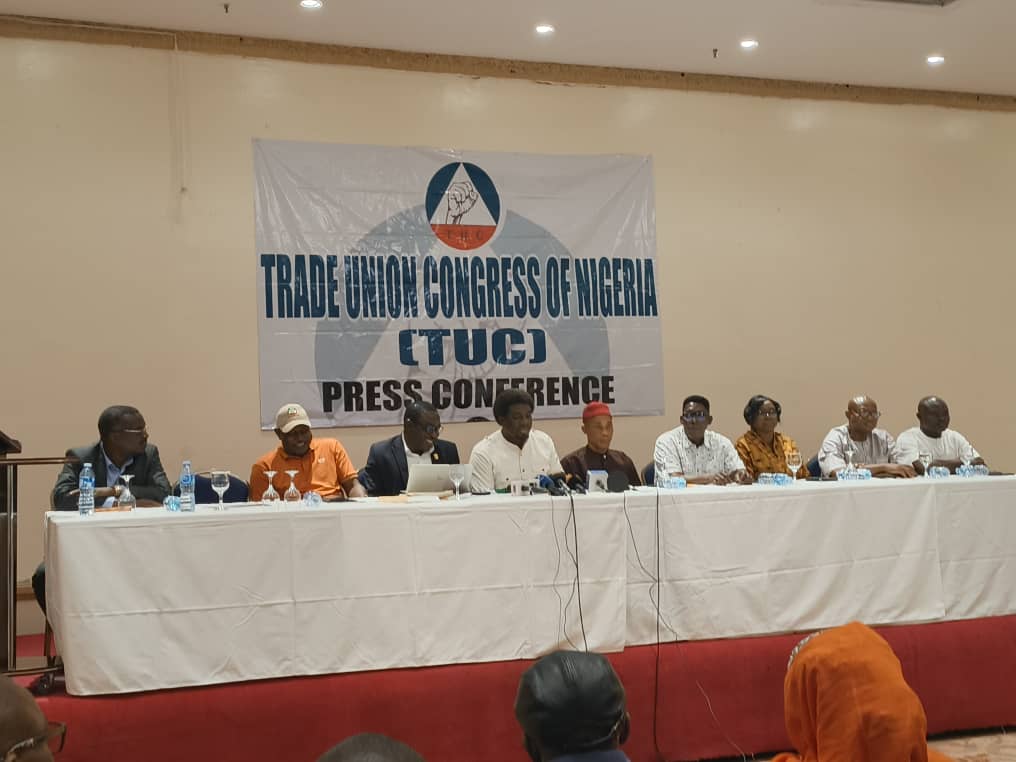
From Atiku Sarki, Abuja
The Trade Union Congress of Nigeria (TUC) has strongly condemned the continuous increase in electricity tariffs without corresponding improvements in service delivery.
According to the Trade Union, Nigerians are being compelled to pay more for unreliable power supply, estimated billing, and poor customer service. Observing that the tariff band system has further worsened the situation, with many consumers charged premium rates without receiving commensurate electricity supply.
Briefing news men on the communique issued at the end of National Executive Council (NEC) meeting of the Congress held on Monday in Abuja, the President of the TUC, Comrade (Engr.) Festus Osifo
insisted that Nigerians must not be forced to pay for inefficiency.
He said any tariff regime must be fair, transparent, service-based, and accountable, and further called on the Federal Government, NERC, and distribution companies to ensure universal metering, eliminate estimated billing, improve supply, and engage Organised Labour before implementing policies that impose additional burdens on citizens.
He said the National Executive Council (NEC) of the Trade Union Congress of Nigeria (TUC) convened a meeting in Abuja to reviewed the state of the nation, developments within Congress, reports from affiliates and State Councils, preparations for the 2026 May Day celebration, and other critical matters affecting Nigerian workers and the general populace.
Comrade Osifo noted that following exhaustive deliberations, NEC expressed deep concern over the ongoing Iran–US conflict and its far-reaching implications for the global economy, particularly in relation to energy prices, shipping costs, supply chains, inflation, food security, and foreign exchange stability.
The President of the TUC noted that despite Nigeria’s status as an oil-producing nation, increases in global oil prices do not translate into relief for Nigerian workers. Rather, such crises often exacerbate hardship through rising fuel prices, increased freight costs, imported inflation, pressure on the naira, and escalating costs of goods and services.
He, therefore called on the Federal Government to treat the situation as both a foreign policy and domestic economic emergency. Saying that Government must take urgent steps to protect Nigerians in affected regions, curb profiteering, strengthen local refining capacity, build strategic fuel reserves, and ensure that any additional crude oil revenue is transparently deployed to cushion the impact on workers and vulnerable citizens.
On the issue on insecurity across the country, Comrade Festus expressed grave concern over the escalating insecurity across the country, including kidnappings, banditry, terrorism, communal clashes, farm invasions, highway abductions, and other forms of violent criminality.
Observing that insecurity has evolved into a major economic and labour crisis. Noting that where farmers are unable to access their farms, food production declines and prices rise, and where workers cannot travel safely, productivity suffers. When communities are displaced, businesses collapse and jobs are lost.
He, however called on all tiers of government and security agencies to adopt a coordinated, intelligence-driven, and community-based security framework.
He said government must prioritise the protection of farms, schools, highways, workplaces, and rural communities.
He further urged targeted support for displaced persons, affected farmers, transport workers, traders, and communities whose livelihoods have been disrupted.
The President of the TUC, who is also the National President of PENGANSSAN also noted the hardship arising from rising fuel prices and reaffirmed that urgent government intervention is required to prevent further increases in the pump price of petroleum products.
He noted that the combined effects of global crude oil volatility, exchange rate pressures, and domestic supply constraints continue to drive up the cost of petrol, diesel, and aviation fuel, thereby worsening transportation costs, food prices, production expenses, and overall living conditions, and called on the Federal Government to allocate part of excess crude revenue—earned above the budget benchmark—to subsidise crude oil supplied to domestic refineries, including the Dangote Refinery and other local refineries .
This approach he said, represents a transparent, production-linked intervention that can lower the cost of refined products without reverting to the discredited subsidy regime.
He also demanded a 50% reduction in taxes on manufacturing companies and workers within this period to ease economic pressure and support productivity.
On the Workers’ Welfare and Housing Loan Scheme, Comrade Osifo received, with cautious optimism, the approval of welfare measures for federal civil servants, including the ₦10 billion housing loan scheme aimed at improving access to home ownership.
Osifo while welcoming the initiative, he also emphasised that policy announcements must translate into tangible benefits.
“The scheme must be accessible, affordable, transparent, and free from bureaucratic bottlenecks. TUC is calling on the Federal Government to ensure that the scheme is not hijacked by privileged interests. State governments are equally urged to replicate similar interventions and extend such benefits to local government workers, private sector employees, and retirees who continue to face severe economic hardship.” He said.
The TUC President while receiving Internal Developments, Affiliates, and State Councils reports on activities within Congress from December 2025 to date and commended the leadership for sustained engagement on workers’ welfare, national economic issues, and industrial relations, he also Council noted significant progress towards the acquisition of a befitting National Secretariat, describing it as a historic milestone for institutional strengthening.
“Reports from affiliates highlighted leadership transitions, internal union consolidation, collective bargaining efforts, and sector-specific challenges. NEC urged all affiliates to uphold constitutional provisions, strengthen internal democracy, and promote unity.”He stated.
Regarding the leadership issue in the Association of Senior Civil Servants of Nigeria (ASCSN), he directed that Congress lawyers review the relevant court judgment and advise accordingly, as well as commended State Councils for sustaining Congress presence at the sub-national level, particularly in mobilisation, engagement with state governments, welfare advocacy, and May Day preparations.
On Lagos State, he reaffirmed its December 2025 resolution recognising Comrade Hannah Omeje as the duly elected Chairperson. reiterating that non-financial members are ineligible to vote or be voted for, and he further noted that the issue of impersonation involving Mr. Abiodun Aladetan and others has been resolved, and appreciated stakeholders, including the Lagos State Government, for restoring order and stability.
Engr. Festus directed the National Secretariat to audit State Councils and ensure that any non-financial member occupying office should stepped down in line with established Congress rules.
NEC he said, also reviewed preparations for the 2026 May Day celebration and emphasised that the theme reflects the urgent realities facing Nigerian workers—decent work, economic justice, social protection, job security, and the defence of workers’ rights.
“Affiliates and State Councils are directed to use the platform to clearly articulate workers’ demands and advocate for policies that alleviate hardship and restore dignity to labour.
“Casualization by employers, and call on the Government to especially the ministry of labour to rise to the occasion and protect vulnerable workers.”
He said,”TUC also condemn the unfair labour practice in the food and Beverages sector particularly the impasse between NAFDAC and Distilled companies, we implore the Minister of Health to intervene by bringing parties to negotiating table. ”
He further called on governments at all levels to prioritize the welfare, dignity, and security of Nigerian workers in all policy decisions.
He said Trade Union Congress of Nigeria remains committed to constructive engagement, social dialogue, and national development. Warning that the Congress will not hesitate to mobilize workers where policies continue to deepen hardship or undermine the rights and welfare of the working people.