


By Usman Usman Garba
International Women’s Day is often marked across the world with speeches, conferences, and policy discussions on the need to empower women and promote gender equality.
However, in Katsina State this year, the commemoration went beyond symbolic statements as the Commissioner for Women Affairs, Hajiya Aisha Aminu Malumfashi, used the occasion to demonstrate practical leadership through humanitarian outreach and social advocacy.
Under her leadership, the Katsina State Ministry of Women Affairs organized a series of activities aimed at supporting vulnerable women across the state, including female inmates who are often overlooked in conversations about women’s empowerment.
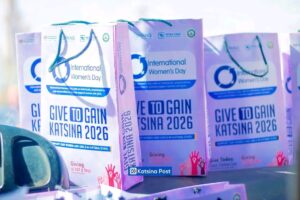
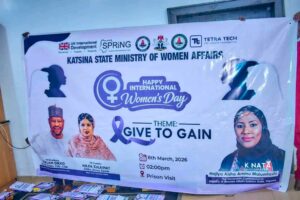
The 2026 International Women’s Day carried the theme “Give to Gain,” a message that emphasizes the importance of compassion, inclusion, and shared responsibility in building a more equitable society.
For the Commissioner, the theme reflected a philosophy she has continued to promote since assuming office: that true development cannot be achieved if vulnerable women remain neglected or excluded from social support structures.
This year’s celebration also coincided with the holy month of Ramadan, a period widely recognized for charity, reflection, and compassion toward the less privileged. It was therefore a fitting moment for the Ministry to demonstrate its commitment to humanitarian service.
One of the most notable activities organized by the Ministry was a visit to the Katsina Correctional Centre, where female inmates are serving various prison terms.
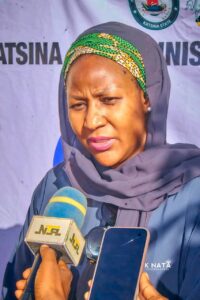
The outreach, led by Commissioner Aisha Aminu Malumfashi, brought attention to a category of women whose voices are rarely heard within public discourse.
Recognizing the significance of the initiative, the First Lady of Katsina State, Hajiya Zulahat Dikko Radda, joined the delegation, further strengthening the message that the state government is committed to inclusive welfare policies that reach even the most marginalized citizens.
The visit was not merely ceremonial. It reflected a deliberate policy approach championed by the Commissioner, one that seeks to ensure that the Ministry of Women Affairs remains actively engaged with women in all circumstances, including those facing legal or social challenges.
During the engagement, the Commissioner and her delegation interacted directly with the inmates and young girls currently in custody, listening to their stories and offering words of encouragement.
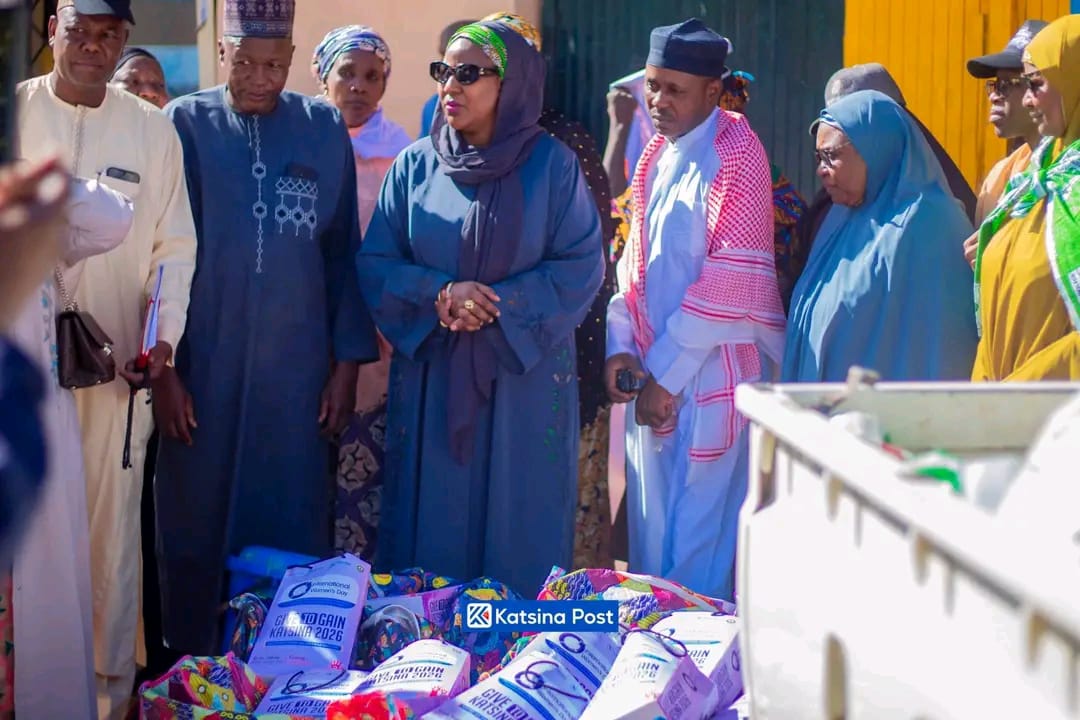
The visit also included the distribution of relief materials such as food items and other essential supplies intended to improve the welfare of the inmates during the Ramadan period.
For Commissioner Malumfashi, however, the outreach carried a deeper message beyond the distribution of material support.
In her remarks, she emphasized that women who find themselves in correctional facilities should not be permanently defined by their mistakes.
According to her, society must recognize the importance of rehabilitation and reintegration, particularly for women who often face unique social pressures and economic challenges.
She noted that the Ministry of Women Affairs under her leadership is working to strengthen programmes that focus on rehabilitation, vocational training, and personal development for women across the state.
Such initiatives, she explained, are essential in ensuring that women who have encountered difficulties in life are given the opportunity to rebuild their futures.
The Commissioner also used the opportunity to remind the inmates that their time in custody could serve as a period for reflection and transformation.
She encouraged them to participate actively in educational and vocational programmes available within the correctional facility so that they can return to society better prepared for productive lives.
Observers say the Commissioner’s decision to prioritize such outreach activities reflects a broader shift toward more compassionate and inclusive governance within the state.
Rather than limiting its role to policy formulation, the Ministry of Women Affairs under her stewardship has increasingly focused on direct engagement with communities and vulnerable groups.
The participation of the First Lady, Hajiya Zulahat Dikko Radda, further highlighted the administration’s recognition of the importance of supporting women through both policy initiatives and humanitarian action.
Addressing the inmates during the visit, the First Lady encouraged them not to lose hope despite their circumstances.
She assured them that the government remains committed to supporting rehabilitation programmes that will help them rebuild their lives after serving their sentences.
According to her, providing women with access to skills training, education, and moral guidance remains a critical strategy for ensuring successful reintegration into society.
The visit generated emotional reactions among many of the inmates, several of whom expressed gratitude for the attention shown by the visiting delegation.
For many of them, the outreach represented more than a charitable gesture; it was a powerful reminder that society has not completely abandoned them.
Some of the inmates offered prayers for the Commissioner and the First Lady, asking God to reward them for their compassion and commitment to supporting vulnerable women.
They also prayed for continued wisdom and strength for the state’s leadership to sustain such initiatives in the future.
International Women’s Day remains an important global moment for reflecting on the progress made in advancing women’s rights while also acknowledging the challenges that still exist.
Across many societies, women continue to face barriers such as economic inequality, limited educational opportunities, and social discrimination.
In this context, advocates argue that women in correctional facilities require even greater attention, as many of them face additional stigma and obstacles when attempting to rebuild their lives after incarceration.
The initiative led by the Katsina State Commissioner for Women Affairs therefore stands as an example of how leadership can transform symbolic celebrations into meaningful action.
By extending support to female inmates, the Ministry demonstrated that women’s empowerment must include all women, not only those in favourable social positions.
For Commissioner Aisha Aminu Malumfashi, the message appears clear: governance must be measured not only by policies and speeches, but also by the willingness of leaders to stand with those who are most vulnerable.
Usman Usman writes from Kano via usmangarba100@gmail.com; 08069771400