


From Sule Aliyu, Bauchi
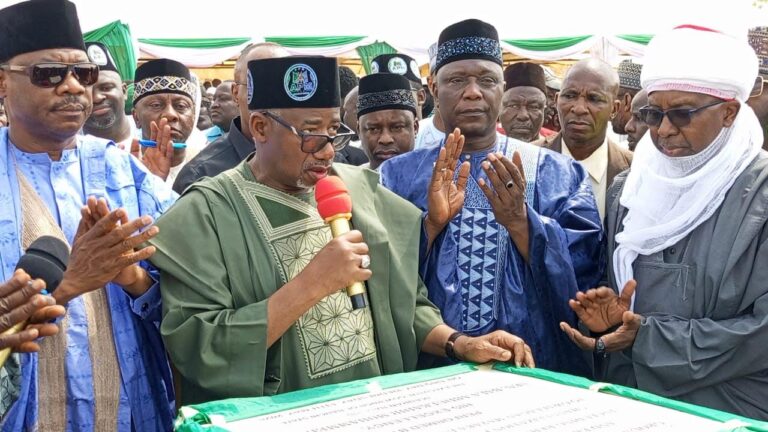
Governor Bala Abdulkadir Muhammad of Bauchi State has flagged off the N29,689,943,588.60 flood and erosion control project under the Agro-Climatic Resilience in Semi-Arid Landscapes (ACReSAL), a World Bank-funded initiative.
Speaking during the ceremony, Governor Bala described the project as a historic intervention that would save lives, protect property, and restore degraded lands across several communities in Bauchi Local Government Area.
“The devastating gullies and uncontrolled flood channels stretching across Soho Company, Sabon Kaura, Wunti Dada, Abubakar Tatari Ali Polytechnic, Tambari Housing Estate down to Yelwa Bridge, and through the Bauchi State College of Agriculture have, for years, constituted a serious threat to lives, property, infrastructure, and economic activities,” he said.
“What began as small waterways where children could easily cross has now expanded into massive erosion corridors, in some places exceeding 50 to 60 metres in width and length.
“These environmental hazards have consumed homes, farmlands, roads, plots of land, and sources of livelihood, while placing families in constant fear and uncertainty,” he added.
The governor added that downstream communities such as Yakubu Bauchi, Salman Adamu Quarters, and Gwalaga Mayaka have also suffered severe seasonal flooding over the years.
“During rainfall, many families remain awake throughout the night for fear that floodwaters may invade their homes, destroy their livelihoods, and sometimes even claim lives,” he stated.
He noted that poor drainage systems and unmanaged erosion have also created serious public health concerns.
“Stagnant water and poorly managed drainages become breeding grounds for disease vectors, increasing the prevalence of malaria and other water-related illnesses within our communities,” Muhammad said.
The governor revealed that the project, awarded to Triacta Nigeria Limited with 40 per cent mobilisation already paid, would significantly improve security and economic activities in the affected areas.
According to him, the intervention will restore about 9,842 hectares of degraded land, provide relief and protection to over 213,000 people, and channel more than 40 million cubic metres of water annually for productive uses, including irrigation and other economic activities within the catchment areas.
“More importantly, the restoration of degraded land and improved water management will open up new opportunities for dry-season farming, landscaping enterprises, and other activities capable of improving livelihoods,” he added.
Muhammad further explained that abandoned erosion corridors and environmentally degraded areas often create unsafe spaces that encourage criminal activities and restrict movement, especially at night and during the rainy season.
“By restoring these areas, improving access, and reclaiming degraded land, we are creating safer and more organised communities for our people,” he said.
The governor stressed that his administration recognises that infrastructure development must go hand in hand with economic empowerment.
“Beyond its environmental and social benefits, this project will generate numerous direct and indirect economic opportunities for our people,” he stated.
He described the ACReSAL project as another bold milestone in the administration’s commitment to environmental protection, urban renewal, public health, economic growth, and the overall wellbeing of residents.
“This intervention forms a major component of the Bauchi Urban Renewal Project and aligns fully with the aspirations of the ‘My Bauchi Project II,’ through which our administration continues to modernise infrastructure, improve living conditions, and build resilient communities capable of withstand environmental and economic challenges,” he said.
Also speaking, the Project Coordinator of ACReSAL, Dr. Ibrahim Kabir, described the initiative as one of the most complex environmental restoration projects currently being undertaken in Nigeria.
He commended Governor Bala’s administration for driving the project from planning stage to execution, noting that comprehensive consultations had already been conducted with affected communities to ensure transparency and smooth implementation.
He disclosed that traditional institutions and community representatives had been integrated into monitoring processes to strengthen accountability and local participation throughout the execution period.
He also explained that support packages and livelihood assistance had been provided to vulnerable persons affected by relocation arrangements, while additional agricultural support programmes would be introduced to enhance dry-season farming activities around Gwallagan Mayaka.
Earlier in his welcome remarks, the State Commissioner of Housing and Environment, Danlami Ahmad Kawule, described the project as another bold milestone in the administration’s urban renewal agenda, stressing that the intervention would significantly improve environmental safety and infrastructure sustainability within Bauchi metropolis.
The Managing Director of Triacta Nigeria Limited, Elias Abu Farha, assured residents that the company would deliver the project according to international engineering standards and within the approved specifications.
The Emir of Bauchi, Alhaji Rilwanu Suleiman Adamu, represented by the Wazirin Bauchi, Alhaji Uba Ahmad Kari, applauded the government for responding to the long-standing environmental concerns affecting the area and called on residents to cooperate fully with contractors for the success of the project.