


By Mustapha Saye
A socio-political group, Nigeria Forward (NF), has urged political stakeholders in Northern Nigeria to uphold the country’s long-standing principle of power rotation between the North and South and allow President Bola Ahmed Tinubu to complete his constitutionally permitted eight-year tenure.
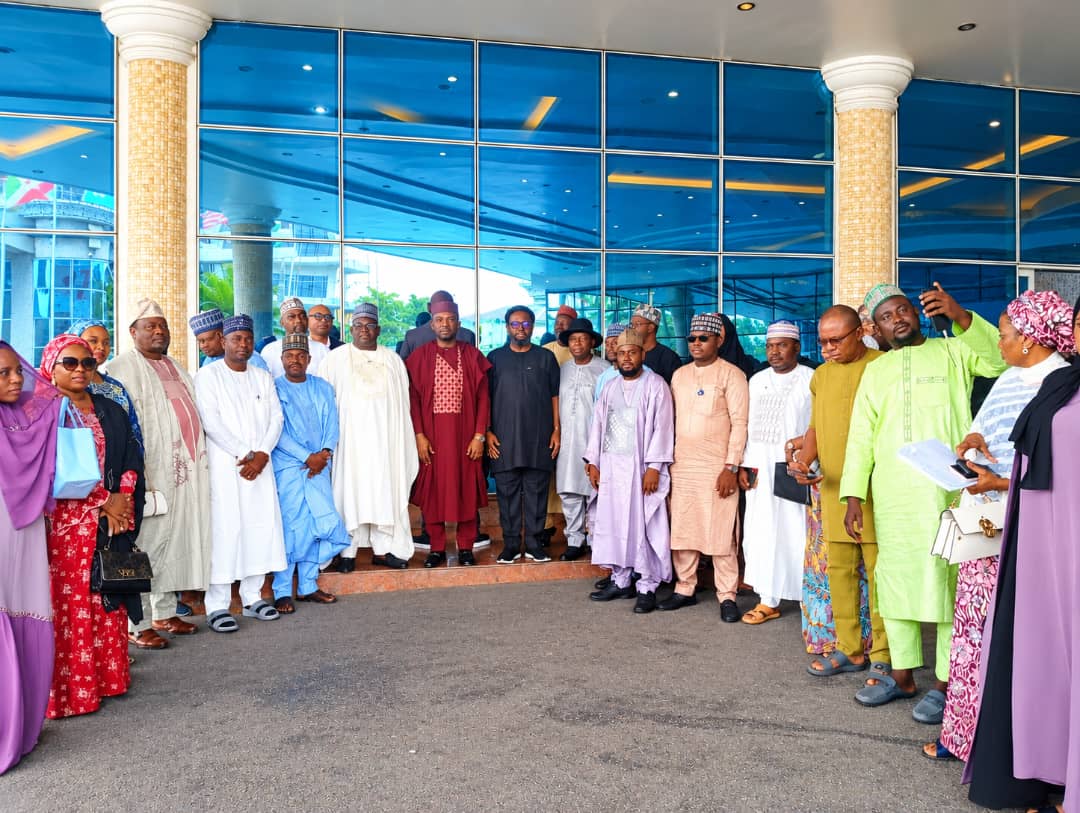
The group made the call on Friday at the formal unveiling of Nigeria Forward, held at Barcelona Hotel, Abuja.
Speaking at the event, the Co-Convener of the group and Kano State Commissioner for Information and Internal Affairs, Comrade Ibrahim Abdullahi Waiya, said Nigeria Forward was committed to promoting national unity, inclusive governance and citizen engagement across the country.
Waiya said the group, which draws its membership from across Nigeria, believes that the North-South power-sharing arrangement that has characterised Nigeria’s democratic politics since 1999 has contributed to maintaining political balance and national cohesion.
He therefore appealed to Northern political stakeholders to respect the principle of rotation and support President Tinubu, who is from the South, to complete an eight-year presidential tenure before the North seeks to reclaim the presidency.
According to him, returning the presidency to the North after only one term could undermine the principle of power rotation and potentially reopen sectional tensions that have historically influenced Nigeria’s presidential politics.
Waiya argued that the North should not seek to reclaim the presidency in 2027 after only four years of the current administration, stressing that allowing the Tinubu administration to complete eight years would provide greater opportunity for continuity and consolidation of its policies, programmes and projects.
He urged political leaders and citizens in the North to place the broader interest of national unity and development above immediate electoral calculations.
The NF Co-Convener said Nigerians should focus more on governance, development and the impact of government policies rather than allowing the 2027 elections to deepen sectional divisions.
Waiya also acknowledged the economic and security challenges inherited by the Tinubu administration in 2023, saying the Federal Government had introduced several reforms aimed at addressing some of the country’s longstanding problems.
He cited local government autonomy, increased financial resources accruing to sub-national governments and moves towards the establishment of state police structures as reforms that could strengthen governance and security.
The commissioner disclosed that Kano State had already established a committee on the implementation of state police, which he said could contribute to job creation and improved security when fully implemented.
He, however, cautioned against reducing the challenges confronting Northern Nigeria to presidential politics alone, stressing that tackling poverty and underdevelopment requires the collective efforts of citizens, state and local governments, as well as other stakeholders.
“Democracy is a social contract,” Waiya said.
He described Nigeria Forward as a bridge between government policies and the people, as well as a platform for bottom-to-top citizen engagement.
Waiya stressed that the movement was not owned by any particular political party, but was established as a platform dedicated to all Nigerians.
He called on citizens to rally around the national interest, strengthen national unity and support initiatives that promote development.
Also speaking, the Minister of Innovation, Science and Technology and Co-Convener of Nigeria Forward, Dr Kingsley Tochukwu Udeh, said the Federal Government’s reforms were aimed at moving the country from infrastructure and connectivity to production, job creation and prosperity.
Udeh said Nigeria Forward would help bridge the gap between government policies and citizens by providing information on projects, investments, opportunities and the impact of government programmes on communities.
He urged Nigerians, particularly those in the North, not to reduce the country’s development story to political slogans, but to examine what was being built, where projects were located, the problems they were designed to solve and the people expected to benefit.
The minister said infrastructure should be assessed by its practical impact on citizens, noting that roads should connect farmers to markets, while railways should reduce the cost of transporting goods and people.
He also identified energy and digital connectivity as critical components of efforts to expand economic opportunities for young Nigerians.
Udeh described the administration’s development trajectory as: “Reform to infrastructure, infrastructure to connectivity, connectivity to production, production to jobs and jobs to prosperity.”
He called on Nigerians to support President Tinubu’s re-election bid in 2027, saying continuity would enable the administration to consolidate its ongoing reforms and development initiatives.
The minister also urged members of Nigeria Forward to make evidence, inclusiveness, innovation and national unity the foundation of their activities.
He said the movement’s slogan, “Together We Move Nigeria Forward,” should translate into a commitment to service, responsible citizenship and national development.