


From Umar Danladi Ado, Sokoto
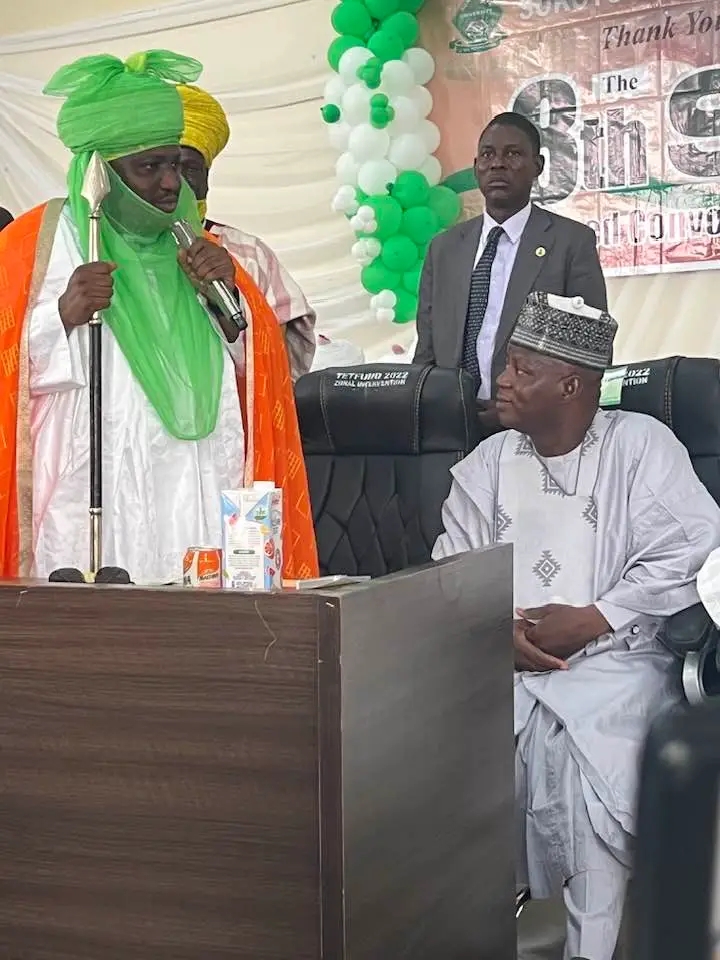
The Emir of Dutse in Jigawa State and Chancellor of Sokoto State University, Alhaji Hameem Nuhu Sanusi, has urged Nigerians to embrace entrepreneurship, innovation and creative thinking as essential tools for national development and global competitiveness.
The monarch made the call on Friday while delivering the convocation lecture at Sokoto State University as part of activities marking the institution’s combined 4th, 5th, 6th, 7th and 8th convocation ceremonies.
He stressed that Nigerians must begin to “think outside the box” if the country is to make meaningful progress and compete favourably with other nations.
According to him, entrepreneurship remains one of the most viable pathways to economic growth, job creation and sustainable national development.
The Emir expressed optimism over the growing awareness among Nigerians, particularly young people, of their responsibility in nation-building, while urging women to take greater advantage of available opportunities.
He encouraged women to be bold, innovative and determined in pursuing their aspirations.
“Women must strive more to take up the challenge. They should not be shy. What a man can do, a woman can do better. If you educate a woman, you educate a whole community,” he said.
The Emir further revealed that the majority of graduates from Quranic schools in Jigawa State are women, describing the development as a positive sign for the country’s future.
Representing Governor Ahmed Aliyu, the Sokoto State Commissioner for Religious Affairs, Dr. Jabir Sani Maihula, reaffirmed the administration’s commitment to prioritising education, particularly entrepreneurship education.
He said the state government would continue to provide adequate funding for education at all levels, with special attention to tertiary institutions.
Delivering the keynote lecture, renowned technocrat and entrepreneur, Engr. Umar Buba Bindir, challenged students of Sokoto State University to harness innovation and research as tools for wealth creation and poverty reduction.
Bindir rejected the widespread characterisation of Sokoto as Nigeria’s poorest state, arguing that such a description fails to reflect the state’s abundant human and natural resources.
According to him, the poverty narrative will persist unless universities, researchers and policymakers focus on developing practical solutions capable of generating employment and economic prosperity.
He urged students to identify Sokoto’s comparative advantages through research and convert their findings into commercially viable enterprises.
Highlighting agriculture as one of the state’s strongest economic assets, Bindir challenged students of soil science and related disciplines to conduct research on the state’s soil composition and recommend crops with the highest productivity and market potential.
He maintained that universities are central to economic transformation, noting that leading global institutions drive national development through research and innovation.
Using Cambridge University as an example, Bindir said the institution contributes more than £300 million annually to the United Kingdom’s economy, stressing that Nigeria possesses far greater natural resources that can be effectively harnessed through research-driven entrepreneurship.
He expressed confidence that with the right policies and commitment to innovation, both Sokoto State and Nigeria could transform their economic fortunes.
Earlier, the Vice-Chancellor of Sokoto State University, Prof. Mohammed Bello Yerima, disclosed that the institution is repositioning itself to produce graduates equipped with entrepreneurial skills rather than job seekers alone.
He revealed that the university has submitted proposals to the National Universities Commission (NUC) for the introduction of new academic programmes in Artificial Intelligence, Cybersecurity, Entrepreneurship and Engineering, aimed at equipping students with skills relevant to the demands of the modern economy.