


Christiana Gokyo, Jos
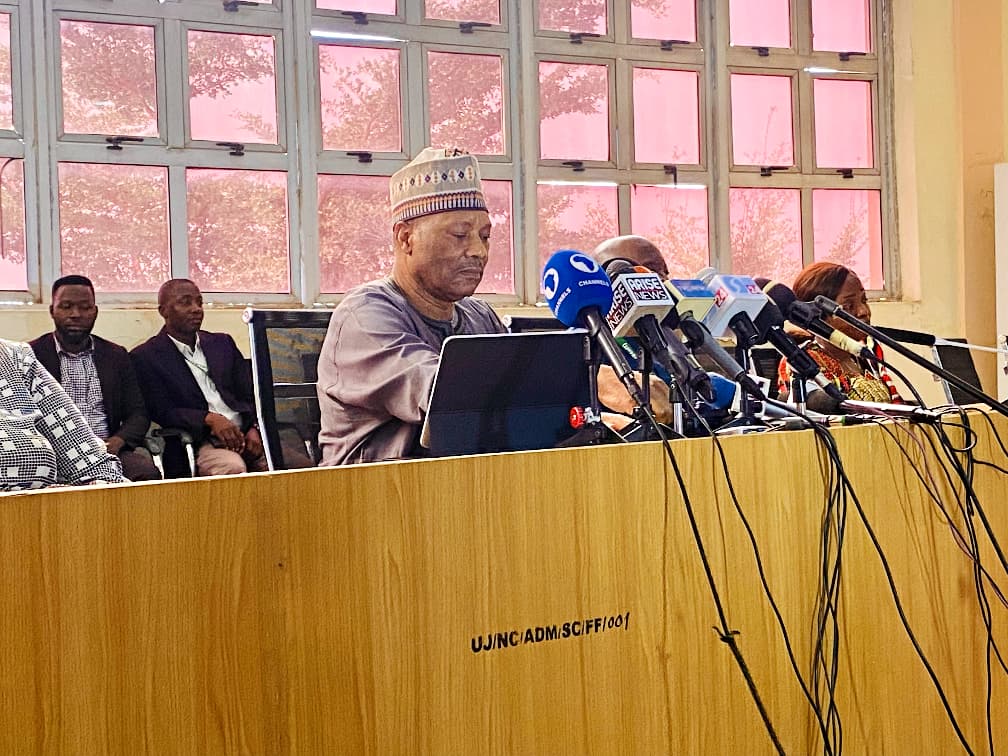
The Vice-Chancellor of the University of Jos, Prof. Tanko Ishaya, has stated that following the Angwan Rukuba attack, the University was not closed.
He called on those who sent buses to evacuate their students to also make arrangements to return them so that academic activities can continue.
He disclosed that the university management, in collaboration with security agencies, has assured all students who choose to remain on campus of their safety.
Prof. Ishaya made this known while briefing journalists on the March 29, 2026 Angwan Rukuba attacks and their impact on academic activities at the University of Jos.
He noted that many students remained both on-campus and off-campus, and that none of the staff on campus were evacuated.
According to him, since the beginning of the attacks, no breach of peace has been recorded on any of the University’s campuses.
Prof. Ishaya further explained that the University recorded five affected individuals four students and one staff member, out of which two students died.
He said that Abel Joro Gershon, a 300-level Building student, was shot in the stomach and admitted at the Jos University Teaching Hospital (JUTH) Intensive Care Unit (ICU). Unfortunately, he died on Sunday, April 5, 2026, and was buried on April 8, 2026.
He added that Ishaya Patrick, a 300-level Geography and Planning student, sustained a leg injury and is currently receiving treatment at JUTH.
Similarly, Duguryil Ufialas Daniel, a staff member of the Directorate of Student Affairs, was shot in the thigh and is also receiving medical care.
According to him, on April 1, 2026, during fresh violence along Bauchi Road, Adyomo Oluwofemi Temitope, a 500-level Quantity Surveying student, left the campus alone and was caught in a violent area where he was shot and macheted to death by hoodlums.
Also, Lonji Malshap Wumnokol, a 300-level Geology student, left the campus alone and was attacked and critically injured by hoodlums in the same area on April 1.
He was initially rushed to OLA Hospital for stabilization and later transferred to JUTH, where he is currently on admission.
The Vice-Chancellor pointed out that normal academic activities resumed after the break on Tuesday, April 7, 2026, while examinations are scheduled to continue on Monday, April 13, 2026.
He assured students and parents that security has been strengthened on campus, along access roads leading to the University, and across the city.
“As far as campus security is concerned, we continuously review and update our plans, covering immediate, medium-term, and long-term strategies.
“In the long term, our goal is to ensure a fully secure campus, with a defined perimeter and comprehensive protection: physical, operational, and digital.
“We are confident that with the deployment of appropriate technology, alongside strengthened physical security measures, we will achieve this objective,” he stated
On calls to relocate the University, Prof. Ishaya noted that institutions are not built overnight, adding that it has taken over 50 years for the University of Jos to reach its current level of development.
He said the existing infrastructure required significant time and resources to establish, and that relocating the university would demand enormous investment and many years to rebuild.
Moreover, he emphasized that a university does not exist in isolation but as part of a broader community.
“Wherever a university is situated, surrounding communities will naturally develop around it. What is most important is to strengthen collaboration, mutual understanding, and peaceful coexistence with host communities,” he said.
He added that the University has been actively building strong relationships with its host communities.
“On record, since the current administration came on board, there has been no incident of any student being attacked within the immediate host communities.
“Community leaders have consistently assured us of their support, and we have seen evidence of this commitment.
“In times of tension, communities have taken steps to protect students and ensure their safety,” he added.
He also noted that the University contributes significantly to the development of its host communities socially and economically, and that these communities increasingly recognize and value its presence.
Prof. Ishaya further revealed that on April 1, he personally visited several community leaders to engage them directly, seek their support, and interact with local youth as part of efforts to strengthen cooperation.
He clarified that the unfortunate incidents involving students did not occur within the immediate university community. Rather, the affected students had left campus and were caught in violent areas, particularly along Bauchi Road.
Available information indicates that the students were engaged in routine personal activities, such as repairing a phone or visiting the bank, when they were caught in the violence.
On the issue of circulating AI-generated content, the Vice-Chancellor dismissed it as misleading.
He said a video trending on social media falsely depicts a chaotic university gate, stressing that it is not the gate of the University of Jos.
“For those who pay close attention, even the logo shown in the video does not belong to the University of Jos. None of our gates resemble the structure portrayed,” he said.
He described the video as a deliberate attempt to spread misinformation and create unnecessary fear and panic within the University community and the general public.